Episode Transcript
[00:00:00] Speaker A: You're listening to the Arbery Digital Experiences podcast, where strategy meets technology.
Got a topic, suggestion, or want to see how Arbery can boost your digital presence? Let's talk.
Visit arberrydigital.com or find us on LinkedIn. Now, on to today's episode.
[00:00:18] Speaker B: All right.
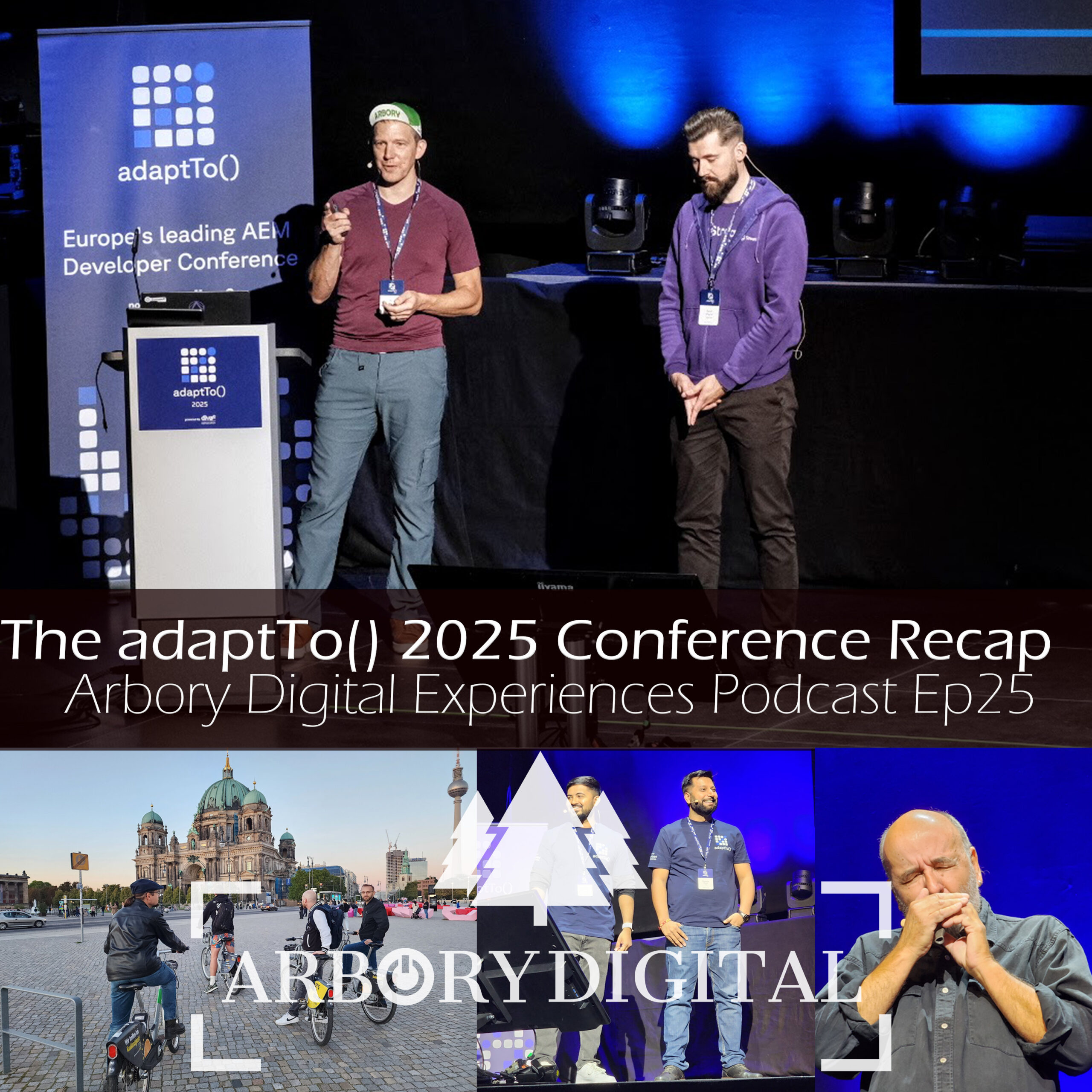
[00:00:19] Speaker A: Welcome to Arbery Digital Experiences. This is episode 25, and today is the adapt to 2025 recap.
I am Ted Reeves, principal architect at Arbor Digital, and today I'm joined by. Oh, my gosh. I'm gonna, like, try to.
Okay, I'm gonna try to. I was just doing French Duolingo, so all my R's are all nasal French R's and not Polish R. So I'm gonna try to say. So Camel chose. Did I do it right? Camel Chozier. Right. Okay.
[00:00:47] Speaker C: Yes.
[00:00:48] Speaker A: Okay. Oh, my gosh.
And Bar.
Bar.
Okay. But I'm call you Bartek for now because that's easier for my ignorant American mouth to say.
And.
And so. And you're from Dynamic Solutions. Bartek and. And K is from Dynamic Solutions, but specifically working on StreamX.
And, and we were all at Adapt to this past year and so this was my second adeptu attended in person. Kama. What was this for you?
[00:01:25] Speaker C: It was my second as well.
[00:01:27] Speaker A: Your second also. That's right. We rode the train back last year's Adapt to. And then Bartek, what about you? How many have you gone soon?
[00:01:35] Speaker B: And this is my third. So first time I was like on my t shirt. 2019. Nice.
So as a regular AIM developer then it was very interesting experience and after a few years I thought that it's. It would be really nice to back and hear about new wins around AIM and all that. Our ecosystem in Adobe.
[00:01:59] Speaker A: That's right.
[00:02:00] Speaker B: Good.
[00:02:00] Speaker A: And then, and then we're, we're coming from three different places in the world, but so both Bartek and Kemmler, you're in Poland. So Kemi, you're back in Bielstock, right?
[00:02:11] Speaker C: Yes, I am in Biostock. And then.
[00:02:13] Speaker A: And then Bartik, you're in Pasman, right?
Exactly. Okay, good.
Well, great. Well, good. So, so we're, we wanted to cover today is. Is a little bit of an overview on the Adapt to conference, because. So this is a. For anybody who doesn't know, this is the, this is the, this is the big AEM developer conference for Europe. And, and it's, it's got a funny positioning in that it's not an Adobe conference.
However, it is attended very well by Adobe employees and always has been kind of traditionally. And so As a result of that, there are a lot of new releases, new pieces of tech that developers like us are going to end up using in the new year. So if you want a sneak peek at what is coming or what is possibly going to be announced at Adobe Summit or what technical things that one should be able to know about for the coming year, it's a, it's kind of a big deal and it flies under the radar because it's also not a marketing conference. It's all just developers.
So.
So yeah. And this year was my first time and Camel's first time being a Adapt to presenter. Vartech, have you ever presented at Adapt to or have you been an attendee so far?
[00:03:26] Speaker B: No, so far I was always sent.
[00:03:28] Speaker C: To me okay actually that last year you had a talk at the lighting.
[00:03:33] Speaker A: At a lighting talk that was like a warmup. That was a warmup and, and that was prepared the night before. I started at 11pm and finished at 1am and I'm like okay, good. I think this is what I'm presenting. But luckily it was the thing that I was in the middle of working on. So I was, it was kind of primed and ready to go. But this one our talk came out was not primed and ready to go. There's a lot of work done beforehand for months.
Yeah, yeah but, but I want to. We can talk about that. First thing I guess we could talk about is, is I guess kind of a setup on, on Adapt to like we. So Bar, you and I were. We. We joined a whole bunch of other attendees. We did a pre Adapt to bike ride in Berlin and that was really fun. That was really nice. I mean Berlin is just such a lovely city to ride around in. So much, so much history. And I had no idea how much of a history nerd you were. Also it was, that was also really, really fun to start talking, Talking World War II history and all that sort of stuff with our ride around Berlin.
[00:04:38] Speaker B: Yeah, that's true. That was really good initiative. I hope it will be continued in next years and I'll be able to join that.
And it's always nice to meet new people, to talk a bit with, grab a cup of coffee right through Berlin.
[00:04:54] Speaker A: And.
[00:04:57] Speaker B: To see the places to share not only technical aim stuff but just meet each other, talk about where we are, what we are doing and with really nice ramen in the evening.
[00:05:11] Speaker A: That's right. That was really good. That was really good. And then, but, but, but also I think that getting everybody just kind of warmed up and talking to each Other because it's a very, it's a, it's a. I. Again, it's a funny conference in that it's a, it's big, but it's little. It feels, it feels personal. And if we are all, if we're all just realize that we're all just a bunch of tech nerds and, and, and, and buddies, that it, to me, it, it, it made, it took. I don't know about. For you, Camel, but, but it for, for me, this sort of thing of. It takes a little bit of the pressure, a little bit of the pressure off of presenting because, you know, you're just mostly presenting in front of friends for the most part. So. Yeah.
[00:05:46] Speaker C: And the large part of the audience are also the speakers.
[00:05:50] Speaker A: Right, right, right, right. They can't heckle you because you know that they're about to be on stage. Yeah.
So, so how was that? Like, I want to get a little bit of a feeling from you. Like, like, like presenting for the first time. Was that. How was that for you?
[00:06:07] Speaker C: Yeah, I was a little nervous, but luckily the stress wasn't crippling, but it was like motivating.
And I think that if someone wants to try to push their boundaries and try to present something to speak on the stage, the Adopto is a perfect place to do that.
[00:06:30] Speaker A: That's awesome. Yeah, I found that too.
It was funny for me because there was a couple other brand new presenters that were up there too. So Arcola and Davanchu had a presentation right around ours also, and they had never presented in front of an audience before. And so I was trying to help, help them not be nervous. And I kind of almost forgot to. Forgot that I was supposed to be nervous.
It's like, oh my gosh, I'm presenting now too. Okay, good, here we go.
So, so yeah, that was, I think that was really good.
So. Yeah, so. So, So I guess when we talk about the actual content of the, of the conference, because I wanted to get into that right now, so I guess we could start out with our, our own thing. So we. So Kamal, you and I presented on, on AM performance in China. And that is, that is a, it's a mega topic that I, I got. We got really good feedback on that too because I think similar to our own experience, a lot of people hadn't really been exposed to the fact that it was a problem and like always almost like assumed that it just all works because it's global or something like that. Did you get that kind of feedback too?
[00:07:38] Speaker C: Yes, I got that feedback and Even on the experts table, we had a people that came there and said that guys, you just showed our example of the issues that we have right now with the content on China for our client and one of those were hosting the content on the cdn. I don't remember the name, but the one that is moving out of the China.
Akamai. Yeah, and Akamai. And they have trouble to find any other solution that works.
[00:08:17] Speaker A: Yeah.
And so yeah, and I know that there's not like a one size fits all on any of this, but I think that at least bringing to light some of the problems that are involved in hosting in China and showing because I mean in the end the solution that we showed is pretty good.
It works pretty well. It's pretty flexible.
[00:08:41] Speaker C: Actually the one that we presented on the stage was pretty simple. It was as delivery service.
But yeah, the solution is not only for the edge delivery services.
In that case it's plug and play. You connect your edge delivery services and just push the content and it works.
[00:09:03] Speaker A: But yeah, the whole relatively simple set of clusters to set up to do that. It's not a ton of infrastructure but.
[00:09:13] Speaker C: The whole platform is prepared to handle more complex scenarios. Like you have data coming from different sources. Like for example it can generate PDPs from the template taken from the CMS and the data from PIM and combine those data and push it to China or any other application.
So it can behave like unified Data layer.
[00:09:42] Speaker A: That's right. And I think that the fact that we can we plug in other data sources, plug in AM and plug in Commerce and plug in PIM and plug in other things like that and have a, have a, have a multi source website which I think, I guess to me that also led into. So the, the talk that ARCO and Machu did was, was all about like running a, the like a, like a practical real world example that they had of, of running AEM and edge delivery side by side which that like to me I go oh well you know, you're licensed for that. You know, might as well, might as well do that. When you buy a cloud service license you got AEM Classic or Classic cloud service and then you've got edge delivery too. And so it's two different content cadences. But like with our, with our solution you could end up doing that in Chime also you could feed both those different content sources and get, get have it be well performing even in China.
Yeah.
Any other, any other talks and I guess we could just get right into that too. Like what, what sort of talks?
Did stood out for you as really impactful, insightful or even just like oh, made you think that you may need to change your mind about an approach that you'd be taking on a customer project.
[00:10:58] Speaker C: Definitely the ACM tool.
[00:11:00] Speaker A: Yes. Yes.
[00:11:02] Speaker C: Yeah, that's if I would still working on AEM projects, that tool would definitely go into my project.
[00:11:12] Speaker B: Yeah, that's a big even I would say game changer.
It gives so plenty of possibilities which were not present in the past with the standard groovy console or needed the custom implementation. Now they are all in. You can especially automate the things.
You can write a script which for sure will be executed right after deployment once and never again. Or you can write a script which clear your packages, do some cyclic events without requirement of doing all the boilerplate stuff around.
That's a big thing.
Served with nice user interface.
[00:11:55] Speaker A: Yes.
[00:11:56] Speaker B: I've even started implementing that for my customer. I did yesterday after a demo to that whole team and they were really satisfied with what they saw. Even asking me 10 content authors use that. No, no, not so far, not so good.
But for us it's really make our lives much easier and much more consistent without those relying on different things which people forget. Like did I executed that script on Dev 5 after deploying it there? No, but QA is shouting now and we have some delays. No, it will be just out of the box.
[00:12:42] Speaker A: That's right. Yeah.
[00:12:43] Speaker C: I mean remember, keep in mind that this tool is very powerful and you can mess your environment a lot if.
[00:12:53] Speaker A: You want to be careful as and as context. For anyone listening, we're gonna, I'm gonna provide links in the, in the, in the YouTube video in the blog post. But, but so this was a, this is Christian and Tomasz that, that presented a new tool to basically replace the Groovy console. Groovy console which came out.
It was, I think it was. It was during, during the war of 1812 that it came out the Groovy console, the original one and, or maybe, maybe maybe early World War II, something like that. It's been around for a little while and, and it was originally it was an, it was a city tech project and then it was an ICF next project. I mean these are teams that have long since gone away. So so, but everybody's still using it. This, this, this tool is everywhere. So this new tool that Christian and Tomas were working on is, is a, is a brand new take on that that allows massive. If you have massive scripted things to do inside of aem, it's immensely powerful.
[00:13:53] Speaker C: And, but Is it still possible to use this classic groovy console on AM as a cloud service?
[00:14:00] Speaker A: It apparently is, yes.
[00:14:02] Speaker C: Okay, yes.
[00:14:05] Speaker A: Even though, even though it sets up alarm bells when you do your best practices analyzer, it says no, please don't but it still works.
[00:14:13] Speaker C: Okay.
[00:14:15] Speaker B: Adobe try to force projects customers to do not do that because if it's a powerful tool and it's easy to break a things and quite often customers then came to Adobe for a help they don't wanna that they try to push customers to use their tools.
[00:14:33] Speaker A: That's right.
[00:14:34] Speaker B: But let's be serious. For big projects, for big migrations, without groovy console and possibility of managing content in that code way, maybe not impossible, but likely impossible to work with.
[00:14:51] Speaker A: Well, I guess that so that to me could segue into another one of my favorite well sets of talks. So in the room at Adaptive we had probably four of the top SREs at Adobe who run AM as a cloud service. And so talks that were led by by Joerg Ho, Dominic Seuss, Primode and Grant.
And there were two different talks basically that were very SRE centric on lessons from like so Yurg gave a great talk on the fact that AM is a cloud service. What are they up to?
A thousand completely separate customer applications.
How many individual instances is he running now? I wrote this down someplace, but it was.
It's a crazy number of instances that they're up and running with and managing and SRE ing on a daily basis.
Let's see, what did he say?
I don't know, it was berserk. But one of the first quotes that Juerg said at the time is like yeah, unfortunately not all of the good practices on AM are documented in any sort of a useful way.
And he had a bunch of other real banger quotes like that.
But I thought that was a fabulous talk on sre.
[00:16:16] Speaker B: Yeah, that's true and it was very good insight view what they are doing there, what the problems the Adobe are facing with.
Because for example, one of the sentences which I thought I remember from that talk is that there is no guarantee of content consistencies between all publishers and CDNs on the single particular environment.
[00:16:46] Speaker A: Right?
[00:16:46] Speaker B: There is always possibility that for 3, 4 minutes publisher a can give something else than publisher B even that if you look into architects architecture there should all point to Golden Publish. But that's the theory. Reality is a reality and it's for me it's a good game because now I know that customer sometimes can see different behavior and that's natural. It's not an error which I have to investigate and handle on as long as it's in some time frames, let's say.
[00:17:23] Speaker A: Yep, I agree and I think one of the things that I really liked about it too also about the, I guess the flavor of Dominic's talk and Jorg's talk is with a super complicated application on shared infrastructure like AM as a cloud service is you'd want to like Adobe sales would want to sell it like oh, it's as a managed service. This is all. You don't have to worry about anything. But in reality there's a lot of empowerment that Adobe needs to provide to people like us to be able to run a reliable service on shared infrastructure. And so that, that's kind of where I, I felt kind of even, even more empowered of like yeah, yeah, we're doing a lot of things on our end to monitor things and make sure they come up and try to pre do a lot of things inside the build as a, as opposed to at runtime and so forth to make sure this stays reliable. But you need to know how all this works so you can, you can keep this, keep your system reliable.
[00:18:25] Speaker B: Yeah, that's true. In on premise versions Adobe stated that it's yours, you're running it on your own.
Generally it's your problem but now it's our problem. So please be quite.
You have not so wide possibilities. We restricted that a bit. But you also have to think better about what you are doing to do not kill the everything.
[00:18:52] Speaker A: Yeah, exactly now but in terms of okay, so. So on the subject of moving or an on premise AM environment, one thing that I thought was interesting was, was the talk on lessons learned from 6.5LTS upgrades because that's I think something that it kind of came out last year.
It was talked about last year that hey, you know, it's going to work on Java 17 and now it's Java 21. But now I think the rubber is going to really meet the road in terms of customers needing to like hey, if you, if you're still running Java 11, you're going to need to get off Java 11. This is something that you're going to need to do this year. So if you're still going to be running AEM on premise, like this is a project this year that you're going to be doing is, is. Is sticking that on premise. Like if you're not going to cloud service, you're not going to edge delivery, you're not going to some other CMS, then you're going to be getting off of Java 11 this year.
[00:19:45] Speaker B: Yeah. That's a big change for the projects who are still behind, let's say. And there are still quite a lot of projects which works even on AM 6.3 without security updates. And they have to speed up, move to at least to new on premise.
[00:20:03] Speaker A: Yeah, exactly. But then, so that presentation that Dinesh gave on cloud service migration, speed up using their AI refactoring service, like, do you remember this one? That was fascinating because I don't know if you've been on any cloud service migration projects. They're like, it's sometimes just, it's like mind numbing, like, because you're just sitting there doing the same types of refactoring.
Like a lot of, like, okay, you're doing, you're, you've got this old service. Okay. You know, this is going to be moving this way. Oh. You get your, your content and your code all mixed up like this. Okay. We're going to separate them like, so there's all these different bits of that that are repetitive, but take a lot of care to be able to do. And you're like, okay, I don't, I don't need an AI thing that generates, you know, images of unicorns riding bicycles. I want an AI to, to handle the refactoring of this cloud service migration. And it seems like it's actually going to happen.
[00:21:08] Speaker B: Exactly. I generally saw on this conference shift how AI is viewed and how it is used now because last year hype was around, let's generate content with AI. And even in demo conditions, that content was usually awful. It looks bad. It was bad for reading.
[00:21:29] Speaker C: No.
[00:21:30] Speaker B: But in this year, this, as we saw about migration, which won't be done by AI, it will be supported if it will do half of your work. That's amazing. You can spend half of time on other things which are more important. Like for example, checking what AI did and fix the corner points.
[00:21:53] Speaker A: Yes.
[00:21:54] Speaker B: And also from generating the content to searching. Because AI, for summarizing the things, for giving you answers if fed well is really good. And there are two talks about that. How to prepare aim to serve content which is understandable by LLMs.
[00:22:20] Speaker A: Yes.
Yeah. That is something that I think a lot of us are going to need to put more attention on this year in terms of making sure that our, the content that we're generating is AI consumable.
Yeah.
[00:22:33] Speaker C: It's not only CR right now.
Yeah. You have to prepare your content for LLMs as well.
[00:22:40] Speaker A: Right.
Yeah. And that whole, the datum that the Adobe folks that was presented the LLM Optimizer, which I heard an engineer behind the scenes talk about that LLM optimizer as Elmo. And now I can't unhear that. It's now it's just Elmo and I want to hear Elmo announcing that LLM Optimizer exists anyway. So sorry, that's my own personal problem. But, but the fact that the LLMs typically almost. Almost universally don't execute JavaScript when they're crawling pages because of the fact that it's just. It's take. It's too compute intensive to do that and they can crawl 20 pages regularly or what was it, a hundred pages or something ridiculous like that in the same amount of time that it would take to Try to execute JavaScript on a page and then crawl it.
[00:23:34] Speaker C: Yeah.
[00:23:37] Speaker B: That'S true. So let's say that server side rendering could have a second peak.
[00:23:43] Speaker A: Yep.
[00:23:44] Speaker B: Quite soon to feed those.
[00:23:47] Speaker A: Yeah, exactly.
Also on the AI side of things that there was the.
What was it Nitin and Fabrizio talked about the the new rag optimized elasticsearch layer inside of AM cloud service like to be able to do retrieval augmented generation of search metadata so that you're going to search for an asset and it's like I want the picture of.
[00:24:13] Speaker B: Of.
[00:24:14] Speaker A: Of a ball like. Like things that aren't actually tagged and they didn't get picked up by smart tags. But you want, you know, I want the asset that I uploaded for it was from the photo shoot last week of you know, Janice giving a talk and then that's a natural language search that that could then get an appropriate result in AM assets and it works on publish too. Apparently they didn't show a demo of that but they said it works on author and publish. So you could, you could generate pages, you could generate search content or even maybe even surface natural language search on your AEM sites and it could prevent.
[00:24:53] Speaker B: Some business case business rules which are restrictive in some companies.
I worked in one project where there were very restrictive rules where product of this customer can be shown with the product of competitor. So if they had 100 of pages or 1000 of pages from advertisement agency nobody have time to check one after another. But with the support of AI of looking for the things in the automated way they could exclude let's say banner of the competitor to do not in any case publish that on their own pages because it's wrong or publish the banner from the last year while article is about this year because it's also easy to omit but in let's say financial or some pharmaceutical industries that may be bet, let's say from even legal point of view.
[00:25:57] Speaker C: Yeah, that actually I think that Adobe guys have shown the published version of this search. They were showing the example of looking for a parking spot.
[00:26:10] Speaker A: Right, that's right, yeah.
[00:26:12] Speaker C: And there also was a query that how to prepare a bump or something like that and it didn't ask for.
[00:26:20] Speaker A: Right, right. Oh yeah, that's right.
[00:26:23] Speaker B: It was secure.
[00:26:24] Speaker A: Yeah, that's right. They were showing that. Yes, that's right. They're showing that on, on their own internal like Internet inside Adobe or something like that.
Yeah, that's right.
[00:26:34] Speaker C: So basically it's, it's, it's a published site, right. It's not. Not on the authoring. Not on the author side.
[00:26:40] Speaker A: That's right.
Yeah. So that's, that's fascinating. And that apparently is a layer that's going to be shipping.
I don't even think it's an extra sku. I think it's, it's just going to be shipping with AM as a cloud service.
As far as I know. As far as I know. I think this, I mean somebody, somebody from a WSL is going to hopefully, hopefully listening to this and say, nope, it's an extra skew. But, but yeah, and then let's see, there's, there's. I don't know if there's another AI one. But you know what, how about, how about this, how about the opposite of AI Bertrand.
Bertrand's talk on the history of sling.
That was lovely.
I love that talk.
[00:27:21] Speaker B: That was amazing because it was touching. So deep history about the sling where I never even thought in that moment when it started that I'll be professional programmer. So it was really nice to hear that from the beginning with the rules which they had in their minds when they're creating and then extending and still developing the sling. So listening that with, with those small breaks for the music. Right. Really lovely.
[00:27:55] Speaker A: Yeah.
[00:27:57] Speaker B: Gives so, so nice view on the overall. So you know why Sling is like it is now and where is it going?
You don't have to ask why they did it like that or that, you know that you know the history.
[00:28:13] Speaker A: Yeah.
And that and his like his, his opening that quote that he, that he gave is like, like because Sling is what it is and it's been around for a long time but it's also been extremely stable. He's like out of fat is so Sling is kind of out of fashion right now, but out of fashion is this very stable state and I love that, I love that. I'm like, yeah, you're right, you're right. Because when you wait when you're out of fashion, you don't have to do the newest, coolest thing. You can just make it, you can just do it. Right.
[00:28:44] Speaker B: Exactly. And this is pink, which is commonly forgotten in nowadays because they are all new things. The, the companies is chasing for the most recent technical features. There is the big AI shift but also AI hype overall.
Yeah, but usually the hype is the hype. But under the hood half or more the financial operations even today are done on the old COBOL written software by people who are retired from many years.
So we're this core but most of the people don't remember or even realize that.
[00:29:30] Speaker A: And with something as, something as basic but as fundamentally sound as slang is, I mean you just look at how many pages that is still serving and it's still going to continue to serve for the next several years. It's going to be, it's going to, it's going to keep underpinning a lot.
[00:29:49] Speaker B: Exactly. And it's good to hear about those strict rules.
If something is released then it's really, really well tested from different angles to be sure that it works like it's expected.
[00:30:03] Speaker A: That's right.
Now in terms of other things too though, so there, there was so Ermie and asli's talk on, on commerce cloud service. That was another good one that I liked because that was something that, so at Adobe Summit this I guess to me is another like difference between Adobe Summit and Adapt to and, and the audiences that you have is that at Adobe Summit they're like, it does this great stuff, it has this, these great features. And then you like, and you're like show me the diagram, like show me how it works. Like what's in it, like what does it do? And you're, and they're like yeah, that will be, that'll be for some other time. And you're like ah. And then you don't, you don't get to like, you're kind of left a little bit unsatisfied. But then, but then they got up and showed a bunch of diagrams and much like yeah, here's how you plug it in and here's how we have our image service. Here's how the documents come in and here's, and here's the add ins and like it. That was like, it was really satisfying to watch it all go.
[00:31:06] Speaker B: Yeah, that's true. And in general the Adapt to conference is really nice for the technical persons because nobody is afraid to show a snippet of a code talk about really low level things which are not consumable by stakeholders, by business people. Here all audience is around the technical stuff in many different roles but all are focused on that. So if you show the architecture diagram, snippet of a code or just have a general talk about how something works, all of that is acceptable. And I think this is one of the biggest strength of this conference.
It's very worth to be there from the perspective of an engineer.
[00:31:56] Speaker A: Oh, I agree and I guess we could almost wrap up on this one. But the. So the lightning talks at the end. So this is I guess to me this is like the adapt to conference ethos like in a nutshell. So the last talk that was Igor's talk on cross environment replication.
So okay, so just, just as a quick, quick sum up. So he gives this talk on, on cross environment replication because. So in AM as a cloud service you have a content backflow functionality that basically allows you to take content that's on prod and stick it on earlier environments. And that's the purpose of it. But what if you wanted to take content on a lower environment, promote it up. That's. You can't do that. So he basically hacks away it it to be able to do it using. Using. He's like oh well you know Durbo replication is turned off on. On cloud service. Well, I don't know how to turn it back on. And you could see the AM sres in the back just kind of going yeah and oh my gosh. So funny is to see that play out in real time of. Of he's giving this presentation and you could see those SREs cringing in the back. It was so entertaining because then, because then. But then due to the number of laughs then you have real time feedback from like your host saying like okay good. So I, I see how people are reacting here.
Okay good. You know there's. There might be a way to do this and, and this is a good idea or something like that. But it was, I thought that was just.
I thought that was just fabulous.
[00:33:26] Speaker B: Yeah, indeed. But it also shows the guys from Adobe that some things are really needed. Those. Yeah, those not are just requests for requesting by. But people require more tools and more possibilities than they provide. For example, you said about content copies.
[00:33:45] Speaker A: Yep.
[00:33:45] Speaker B: Nice. It was working really nice for first two months but after that they have put some restrictions within it and for me it's useless even content without them moving between instances usually fails So I just drop down that tool.
[00:34:03] Speaker A: Yeah, it's true. It's true.
But to me, what that, what it does to have a conference like this with, with people who are senior engineers from Adobe is to me, it really personalizes Adobe as a company.
Because when you are from afar and you are, you are like, I mean, I'm in the middle of a forest and you guys are in Poland, like, you're not next to Adobe Headquarters and I'm not next to Adobe Headquarters. So sometimes dealing with this big company can feel when you're, when you are, when you haven't gone to conferences like this, it can feel like you're, you're up against a force that you can't deal with. It's just a, it's like, it's like you're fighting and fighting something that you can't actually articulate or work with.
But when you come to a conference like this and you're like, give a presentation like your Gord gave of like, I've tried to solve this problem and here's my crazy solution. And then, and then, and everybody laughs. But then you have engagement from, from actual Adobe engineers and then you could, then you could start the ball rolling on, you know what? I think you're right. You know, we should fix this. How do you, how would you ever get that sort of personal interaction any other way than a, than a. In a very intimate conference setting like that? Which I think is. That's what makes it so special.
Yep.
[00:35:30] Speaker B: Yeah.
I think only possibility yearly to maybe accept Adobe Summit. But there is, there is harder to find that people.
[00:35:39] Speaker A: Yes.
[00:35:40] Speaker B: Here is small group. You can grab a coffee and go speak with your. For example and ask about features or problems which you have in your mind. But you cannot push them to Adobe and get real answers. Here you have live person responsible for that and you can just talk with him.
[00:36:01] Speaker A: That's right.
[00:36:02] Speaker B: That's amazing.
I even raised a dispatcher security issue with York during that conference. We showed that to him and then summary go via email.
So it was. It wouldn't be possible in any normal conditions, but during this conference it's quite easy.
[00:36:26] Speaker A: Yeah.
[00:36:27] Speaker B: And even if you don't know who to talk with, you can go to the session experts to the expert sessions. There are plenty of topics, I think six common, six, let's say core topics and specialists assigned to them. You can go and just, just ask, ask a question. Somebody will try to answer you and help.
[00:36:49] Speaker A: That's right. That's right. Yeah. I think it's great.
[00:36:51] Speaker C: And I.
[00:36:52] Speaker A: And this is where so I really, I hope to just see this all just, just continue in terms of, in terms of this dynamic of being able to have a, have an, a very intimate technical only no marketers and sales guys and recruiters and all this other, all this other stuff. That is a, it's that, I mean, that's a core part of our ecosystem. I'm not saying that any of that is bad. That is why Adobe Summit is so important. And I'll keep going to Adobe Summit every year too. But that this, this is such an, a necessary core function to kind of keep the, keep the whole, you know, show on the road.
[00:37:35] Speaker B: Yeah, that's true.
Adobe Summit and Adapt to are complementary.
[00:37:40] Speaker A: Yeah.
[00:37:40] Speaker B: Yeah, for sure.
[00:37:42] Speaker A: Yeah.
Well, good. Well, I think that, that, that can wrap us up here and, and yeah, next, next. So next year we're gonna, you know, we'll be there. I'll, we'll, we'll lead the pre adaptive bike ride again. I think next year I'll also make sure to send out the word a lot earlier because that was the only thing I got irritated. People saying, if I had known a little bit earlier, I would have put my bike on the train. And, and, and now I also know not to try to take my bike on a train all the way across Poland. Also.
I'm aware of this limitation, you know, after spending the night in a small Polish village train station alone. So, you know, you learn things. I learned all kinds of things at Adaptive.
[00:38:26] Speaker C: So it would be much easier if you would just rent a bike.
[00:38:30] Speaker A: Yeah, the release, it would have been easier. Yeah. I think that the number of people who are like, why didn't you just rent a bike? But yeah. So.
All right, good. Well, thanks you guys for coming on and we'll talk again soon.
[00:38:44] Speaker B: Thank you very much. It was really nice recap.
[00:38:47] Speaker A: Great. All right, bye.