Episode Transcript
[00:00:00] Speaker A: You're listening to the Arbery Digital Experiences podcast, where strategy meets technology.
Got a topic, suggestion, or want to see how Arbery can boost your digital presence? Let's talk.
Visit arberrydigital.com or find us on LinkedIn. Now, on to today's episode.
[00:00:18] Speaker B: Hello. Welcome Back to the 26th episode of the Arbery Digital Experiences. I'm joined today by Bryce Acker, CEO and Principal Architect at Arbery, and Tad Reeves, two time AAM Champion and Principal Architect at Arbery Digital. And gentlemen, how you doing today? First off? Doing well.
[00:00:35] Speaker C: Doing well.
[00:00:36] Speaker A: It's so bad.
[00:00:37] Speaker B: Yeah. Does it? You know, I, I know that Tad, you've been doing a lot of traveling and Bryce, you did a little bit as well. And here recently there were quite a number of events out in San Jose, California that Adobe put on, and I'd love to hear your thoughts and takeaways from some of those events. Tad, do you want to start? Because I think we had a conversation about this, but I was asking you where you got that amazing jersey, and I didn't know if it was just in the, in the, you know, archives of Adobe SWAG that you've acquired over the years, but, you know, I'm always curious.
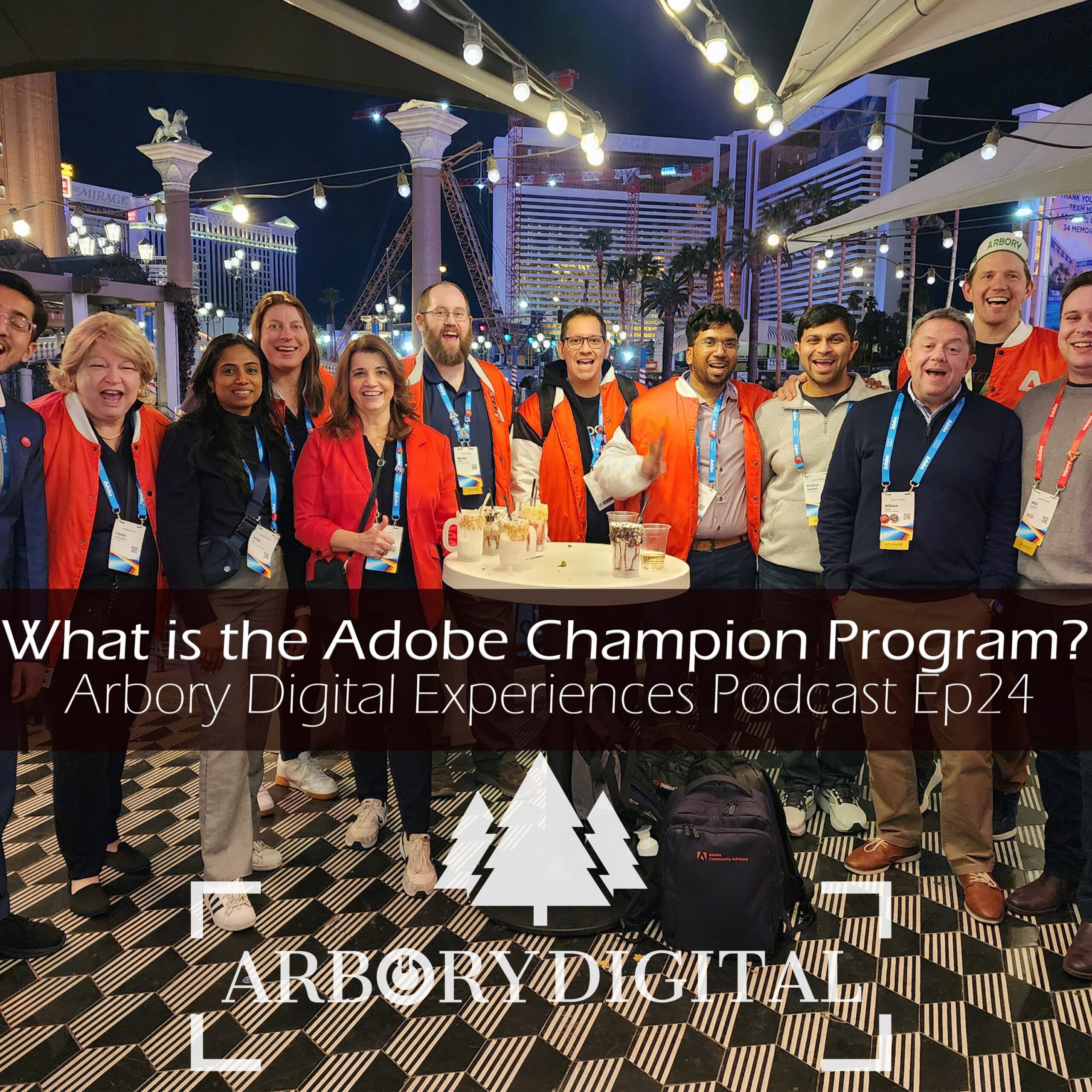
[00:01:09] Speaker A: No, this is a new one. So this was, this came from the Adobe Champions Forum and that was the first of three events that happened in, in November. So Adobe headquarters is in San Jose. That's where they, they own their big section of San Jose. And, and so the first of those three was this big Champions Forum which our last bike ride podcast tackled. But the, this was, this is basically all, all the top folks in analytics and marketo and commerce and AO and, and, and, and am. And that was why I got the invitation was for the AM side of things. But did you work.
What was that?
[00:01:50] Speaker C: Workfront work?
[00:01:51] Speaker A: That's right.
There's six of them and I always.
[00:01:53] Speaker C: Forget one of them.
[00:01:54] Speaker A: There used to only be three and now there's six, and so I can't keep track of them all, but basically it's everything having to do with, with Adobe's experience in commerce, cloud platforms, and, and which is basically everything it takes to get a website out the door.
[00:02:07] Speaker B: Yeah.
Fantastic. So this was where the photo came from of you doing the handstand like Alex Carp recently.
[00:02:14] Speaker A: That's right, that's right, that's right. That was not AI. It was actually everybody was viewing a group chat and then I, I'm like, right here I'm gonna do this. I do a handstand and the guy behind me is just kind of like going like what are you doing here?
It's actually really funny. I sent it to my daughter and my daughter goes and circles the poor fellow who wasn't really prepared for that. So.
[00:02:34] Speaker B: Oh my goodness.
[00:02:35] Speaker A: But, but yeah, it was great. It was great. It was, it was a whole. So, so number one, all the folks that were there, like usually like we go to Summit every year. Right. And so, so Summit's always like a smattering of like, like devs and, and you know, personnel people and, and people who wished they, you know, they just wish the event were over so they can go drink and like what, whatever it is, right. The market, marketing people. Yeah, this was all just hardcore practitioners and for the most part these are all people who also got there because they are busy communicating out to the world. So there are all these kind of like jazzy out there extroverted people. Like it was, it was pretty wild. So. So it was great. It was great. It was, it was meeting with all those guys and then we got a whole bunch of inside access to like Adobe product and stuff like that.
[00:03:24] Speaker B: Well, and it's always nice to get that perspective and get that you know, kind of more condensed down view where you're getting some really heavy hitting, like minded people in the same building to throw ideas around, talk new technologies, tools, products, paradigm shifts that might be coming down the road.
Bryce, you were out there as well. Now which, which part did you take in so?
[00:03:45] Speaker C: Well, first of all, it was just fantastic being back in San Jose.
I actually worked out there at Adobe headquarters about a decade ago.
So I worked out of the San Francisco office for a while, but I did the machine language translation API in AM 6.0. So that was the first 1.0 machine language, machine language sort of translation piece in AM. That was about 2013, 2014, something like that.
So I hadn't been actually back to the, the headquarters building since that they've actually added a whole new tower.
But you know, it was nice to reconnect there. Just be back in San Jose.
I actually took a Drive down 17 just south of town through, through all the tall, tall trees and visited my cousin Carmel too. So it was, it was really nice to be back in California. I think the last time it was when you and I are out there in the Sequoias and it's just such a beautiful place on the planet.
But I actually was with Tad at the, the masterclass focused on EDS document authoring and, and that was fantastic. There's about, you know, like, like ty was saying 40 or 50 really developers, architects, engineers and really the core sort of EDS engineering team from Adobe putting that on. And they did, they did a fantastic job.
So I hope they do it again. It was the first one and I, I gave five stars rating and hopefully their ratings as well because I know that that inspires their leadership to, to do more of these.
[00:05:19] Speaker B: Yeah, absolutely. And, and Tad, you kind of mentioned it earlier with Summit kind of being a. More of a, let's say gregarious because it does all encompassing technology and disciplines and so it doesn't really break off into maybe those deeper conversations. But do you see the Masterclass and Chance Forum and Dev Developers Live, is that kind of breaking those apart that then when it all comes together later on, say this coming year, next year in April when Summit's going to take place, is it kind of seeing all these pieces that then will scale up and then become the entirety.
[00:05:54] Speaker A: Yeah, it's, it's. I mean a lot of what we're seeing is things to prepare for for Summit. Summit is such a, such a moving audience and it's, and Summit is also your, you got a lot more in the way of customers and potential customers that have their eyeballs on Summit as well as investors and, and so, so, but, but this, this, this couple of weeks was a, was a much more singular focus on, on practitioners, which I really enjoyed. So that, that's from like future of where Adobe is headed, which is really. We're at a kind of a crazy inflection point, Frank. Yeah, I think a lot of people get all like, oh, Jenny, I, you know, with pictures and like. No, no, no, no, no. There's actually some, a lot more fundamental shifts that are around the corner that I think that a lot of us are kind of, some of us are, are going to get dragged in kicking and screaming and others are, are, are going to be, you know, really pushing for this all to happen. And I think that it's, it's, it's important to, to understand kind of the major, some of those major forces that are at work.
[00:06:53] Speaker C: Yeah.
As big of as the RE architecture from like 5.25 to 5.3, which is a long, long time ago now. And then even, you know, when they launched with 6.0, it was a big overhaul of the platform itself at that time.
This is just as big of a line in the sand. Oh yeah. There's going to be a before and an after of the changes that are going on right now.
[00:07:14] Speaker A: Right.
[00:07:14] Speaker B: So this isn't an incremental step. It's a major step.
No, potentially, this is what.
[00:07:20] Speaker A: No, no, it's not even potential. I think it's so, so it's, it's actually really timely too that all this is kind of, all this is kind of like getting you because so, and, and we even, they even kind of announced it and they had a little, little party going on at Dev Life to celebrate the 15th anniversary of, of there being such a thing as AEM.
Because it was 15 years ago, as of October 29, that Adobe purchased Day Software and, and then turn that day CQ into what we all know now as, as, as this mega brand of Adobe Experience Manager.
[00:07:55] Speaker B: Fair enough. Yeah, I understand that you got a chance to talk to Adobe Product Management. What were some of the key takeaways that you got from their presentations?
[00:08:03] Speaker A: Tad well, okay, so some of it I'm at liberty to talk about and some of it I'm, I was told not to or else I'd be shot. And so I'm going to try to only, only say the stuff that I'm supposed to right now. And so we'll, we'll have, we'll have Adobe Sensors reviewing this later to make sure that I didn't go off the rails.
So that's one way to make sure they watch the podcast. So, so for, for one thing, so the, and this is, this is something that that was said and restated a couple different ways and which is Adobe is now tracking this idea of, of a dual engagement imperative is how they put it, which is where you basically have, you have to design all of your content strategies and your tooling strategies around the fact that you're going to have agents and humans being on equal footing. And that, and that's something that is kind of, is kind of wild and it's kind of different and it kind of changes a lot of your math as to like, well, do I really want to put 15 sprints into redesigning my Mega Menu? Because that's how long it takes in, in my traditional CMS or something like that. Like, no, y', all, you gotta get, you gotta get through that a lot faster because you need to increase your content velocity and make sure that, because the, the, the, the, the agent doesn't care what your Mega Menu looks like. They're just going to scrape your content.
And, and we're already seeing this, we know this from our LM optimization discussions. We're going to get into that in a bit. But organic SEO traffic is falling off on a lot of major websites. The whole Idea of who and what is using your content is totally changing a lot of the fundamental like decisions we made around oh wow, I'm going to get people to come to my own website and all that's only 20 years old. That whole idea that everybody's going to create your own website. Before that they weren't and now they might not either. They might be going, so what do they call this?
[00:10:04] Speaker C: They had a great.
[00:10:05] Speaker B: Mark, I think I was going to say. I think you're going to say the same term or concept I was thinking of, which is, is it the zero click interaction? No, no, I thought that was really interesting.
[00:10:17] Speaker A: Yeah, so, so Mark was, was talking about this idea that, that you're, that that chat GPT and things like that are.
You could call it your off site property.
[00:10:28] Speaker C: Right.
[00:10:28] Speaker A: Because honestly a lot of your content now is going to be being consumed by these other engines and reformulated and stuck on a copilot or perplexity or a GPT or whatever.
[00:10:41] Speaker C: And really, I mean these are all content management systems. But what content is changing too. And it's exactly the structure, how to present it and how to in this dual model of, you know, human visitors coming to your site, but also agents coming to your site and like you said, really equal footing moving forward or at least equal importance so well and.
[00:11:05] Speaker B: Surfacing that content, making sure that it's actually able to be read and interpreted by whatever LLM is coming to it and finding the sources that it's trying to cite back to the user that's, you know, putting that prompt in and really I think that's what you're speaking to as well is that's kind of changed the landscape of how we think about visitors coming to the site versus their agents kind of viewing it from a distance and almost I think they were mentioned as kind of like ghost visitors or ghost shoppers like the agents themselves and being able to detect them to that point.
I know you said you can't say much. Do you have any thoughts about what might be coming down the line for Adobe Summit? Tad?
[00:11:47] Speaker A: Yes, yes.
[00:11:48] Speaker B: I don't mean to push too much.
[00:11:49] Speaker A: But yeah, no, so a lot of that was, was then what was then detailed some more at Dev Live. And so we're kind of blending a couple of events in this case. But the, but the, but so in, in that whole dual engagement bit then. So consumers are using agents, but that also means that, that web producers also need to be using agents and, and you need to be using a framework that really enables those agents. So this Means that we can't be in a CMS where you're spending tons of time just upgrading a version or something like that. You need to get to a point where agents can easily operate en masse on your content and you can quickly roll out new changes and really enable these kind of agent driven experience operations.
One of the ways that, that, that the Adobe folks put it where you can, where you can push things out rapidly and be able to use an agent to go and say good, make me a bunch of new content based on this stuff in, in this ways, in these languages.
Get it out there right now and, and go and, and be able to, to, to, to push out authoritative brand content that is that, that, that is quick.
So that's, I think that's, there's a, there's a whole host of agents that Adobe is working on. These are content production agents and, and delivery agents and, and brand awareness type agents and so forth that, that, that they want. So designing an entire infrastructure just around, you know, load averages and page views and stuff like that, that's, this is where Adobe, Adobe folks themselves are going. You shouldn't really be focused on your page views anymore because.
[00:13:33] Speaker B: Right.
[00:13:35] Speaker A: It's just not where people are at.
[00:13:37] Speaker C: Yeah, it is a signal, but not as important as it historically was.
[00:13:41] Speaker B: Well, it, yeah, I would, I would actually like to ask you that Bryce, you know, visualizing your system, visualizing your traffic insights, all of that vantage point. Right. How it generally was viewed through certain lenses and now again we're looking at it through how do we track the agents and users that are throwing queries at us and what are their prompts?
Do you think that it's necessarily, it goes away as far as SEO or is it just now we're going to have to run both? I mean I look at it from the vantage point of now you just have more data. I mean I don't think SEO necessarily goes away. I think visitors still will go to the sites they use and trust and I actually think it might develop sites into powerhouses. Right. Like a long term website that is tried trusted.
You might look at the citations but there's still going to be those users that know what they want instead of going through an agent and prompting it.
But really do you see that kind of as a two prong methodology? I think going forward if you're going to have to manage both sides of that coin and if so, how do you do that? And does managing SEO affect Geo or vice versa?
[00:14:55] Speaker C: Sure. I mean it's going to be all the above, you know, on, on the consumption of LLMs, on, on current content, on legacy content, on future content that's still being fleshed out. I mean there we don't, we have some answers but that will be changing over time as, as we go.
You know, I think that there's going to be still a lot of interaction with, with all these marketing websites and you know, especially with experiences on websites, maybe the actual like content like fact pages or, or detailed specs or you know, long form PDFs, those are going to be consumed by the LLMs and they're going to be regurgitated in, in to your, your chat GPT, your deep seek, your, your whatever prompt responses and you know, hopefully they source properly, you know, to, to send visitors back to those original source content. But if it's quick answers like that that users are looking for, they're not going to then go to the websites anymore for those. They got their answer, they got it out of, of the AI.
But you know, I think that there will be, you know, more reasons to come to websites in the future for, for more rich interaction, more rich experiences. So that aspect of it's probably going to change. SEO be there for the future. I mean I think you know, this sort of topic, a little bit of what we're talking about, but the legacy search engines are still trying to figure that out. Right? I mean they have their own models that are built on advertising and click throughs and so those are in real time being retooled, rethought, blown up, you know, no longer used, but they still are very, very valid in a lot of cases. And it goes into what Adobe just their purchase recently of SEMrush. Right.
Clearly SEO is still around, but it's going to be a blend of SEO, geo, whatever the terms are that we want to call it moving forward, but at the end of the day content is king.
And these tools and these systems are going to help content teams be able to deliver content to end users and build new unique experiences. But also you know, give insight into how to structure your content for again this dual mandate, you know, needing to have a website that when you know, real users come in that you know, needs to look and feel right. People need to understand how to interact and how to find the content they want. But at the same token, you know, you need to be able to feed the beast that is the LLMs and, and be able to, to have that same content in maybe a different format, maybe the same format, but maybe a different format to be able to really succeed in, in content placement and resourcing from the. The. The AI answers essentially.
[00:17:51] Speaker A: That's right. And there's so there is a.
One of the presentations that was given so this. So Cedric Hisler and Martin Birgi gave an absolute. Just.
It was one of the more insightful presentations. We're going to stick a link to this in the, in the show notes of. Of this presentation they gave because. Because it was. Because it was kind of a double header of.
For everybody who doesn't know, here's how an LLM works and everybody should know how, how your average LLM works in terms of how is it that they answer questions and then how do they interact with your site and then what do you need to know about your own site's construction so that you can make, make sure that you're showing up because little things that their research showed things like if you're not. If, if your site isn't answering up within three seconds it's completely discarded.
So if, if you've got a legacy cms right. Some of those things your dynamic pages take a little bit for your. Oh yeah we know our product display pages sometimes take a little while but you know what? They're not going to get cited at all if they take three seconds.
[00:18:47] Speaker C: Sure. You're stitching in content from different sources, different area, you know, to the human experience. They, they might have the patience for that load or they can see that loading but the, the agents themselves likely don't or in the current iteration they don't necessarily.
That's changing in real time. Right.
[00:19:02] Speaker B: But right. That was going to be a follow up to. That would be you know, okay if it, if it's based off of that, that, that timetable. Right. Three seconds or less.
Is there a possibility that again if you want to enrich your data you could say allow.
Do you see what I'm saying Or.
[00:19:19] Speaker A: Going with that like, like you watch one of these agentic searches happening in real time. Like if you go use you know Google AI mode, you use Gemini or, or something like that. One of these ones where it's actually going and thinking and going off and, and, and you say good. Tell, tell me the, the give me three ways that we, that we could solve this problem that I'm running into. And here, here are my problem criteria and it's going to have to. And then, and then here here your documentation sources go and it's going to go and start searching through documentation searching through blog posts and all kind of stuff. You're just simply not going to get, it's having to go off and present, provide those responses. And it's already programmed with like, you know, y', all, we don't got time for, right, you know, something to be slow. Like you either respond or if you don't respond good, you're, you're out, you're, we're going to go to something else.
But, but back to one of the other things that you were talking about earlier Bryce, in terms of monetization because this is one of the things that is mega influx and we're going to see this change over the next year or so. Because right now we all know that Chat GPT and so forth, they don't have sponsored results. There's no framework for sponsored results in there right now. How, and we all know that it's completely unreasonable to assume that everybody's going to have a 200amonth chat GPT subscription and that's how they're going to pay for all those GPUs. They're just not, that's not going to happen. Right because folks have already done the math. Like in order for them to break even it's going to be the equivalent of like 300 million people having $150 a month subscription in order to pay their bills. It's just simply not going to happen that way. The only way to do that is with, is, is by, by letting brands pay to be, to be featured. And so Martin gave a really neat demo of using Edge delivery and using DA to go and, and, and create and push a web component and embed it into a chat based experience in chat GPT.
And so to basically say hey, I, I, I'm really super interested in one of these pairs pants. And then, and then one of the things is oh, would you want to shop for one of these right here? And it goes, and, and then now there's a web component that is rendered from your website and you can go and look at a couple different angles of this thing and say yeah cool, I want to buy, go buy. And then you can buy it. Getting featured in something like that, that is totally a way that Chat GBT could monetize themselves.
So because, because now, now you're driving commerce now. So, so there is, there is a, a web off of these, you know, third party properties that aren't on your website that are going to be what people are going to be designing. It isn't just going to be, we're going to assume they, they arrive to our SEO pages and they click through off our main nav and then they're browsing around our site. That funnel is not going to exist.
[00:21:57] Speaker C: Yeah, that's a fascinating, you know, aspect that the, the future browser might actually be. The ChatGPT prompt.
[00:22:05] Speaker B: Exactly. Yeah, that's what I was just thinking of and it just reminded me of taking off and developing flight and leaving. You know, just again we're talking about speed and, and response times and you know, it's really a symptom of the culture in the day and age of the technology and where we're at with information and how rapidly it comes and goes and I want to order my food now and I want to have this experience now and it's, it's, it's gotten to that point where we can't imagine dial up days and slow response times and everything's so immediate. So to that degree, you know, you can see the writing on the wall. I think last year even at Summit obviously there was agentic AI was a hot topic and it was talked about. But I think the shift from, from last year even to now is, almost feels like a 180.
[00:22:58] Speaker A: Yep.
[00:22:58] Speaker B: I mean it, it's just, it, it's, it's come on so quick and, and, and so rapidly and, and, and again it has people that get worried about it and of course, you know, anytime a new technology comes wrong, this disruptive, it's going to have some ramifications in certain aspects. But to that end of development and, and rapid development. Right. And, and really those unique enriched user experiences, how does that couple. And I'm going to switch topics here a little bit with EDS because I heard an interesting tagline that one of you brought back from, from the masterclass and it was a slogan that kind of went towards speaking to EDS and, and the turnaround time and what I have in front of me, it says see what we can do in two weeks. Yeah, right. And I want to follow up by saying, you know, we've done work historically arbore digital with edge delivery services, obviously with the first implementation of doing a entirely service site through edge delivery.
What going from then to now and having really had time to work with it and develop on it.
What's your feeling towards that slogan? What, what, what is achievable in two weeks? Right. From, from either of your aspects.
Sure.
[00:24:22] Speaker C: So yeah, so that was actually a quote I captured from one of the Adobe engineers, Sean Steimer, and actually you know, a great friend of mine and, and we go back to my very first company out of college.
We, we actually went to the University of Dayton together. Shameless Plug Go flyers.
But he's one that mentioned that and it was in a conversation about how even Adobe is tackling these projects with the customers.
And it's the very same thing that we're doing as well at Arbore Digital.
Meaning, hey, give us two weeks, we'll throw together a proof of concept and you're actually going to be very impressed with what we can get done in two weeks. And this goes down to how they've structured this product in the whole platform itself and the tools that they're really holding onto this to aid two things. One, the speed of delivery and development, but also the speed of content generation and really ingestion and migration.
So at the end of the day they put together a very nice framework to be able to bolt in. Like we've been talking about all these different agents and all these different tools where you can take an existing site, for instance, let's say, you know, a large financial institution and we can take their marketing.com and you know, quickly stub out and put together a code base and a framework on EDS and have, you know, an LLM go out, ingest the content in and you know, prep the content, prep it and get ready. And also at the same time have a very rapid development team that can iterate on various features, on templates, on the look and feel of the site and really put together sort of a migration plan and a very like, for like demo site very quickly, in this case in two weeks. But the long migration times where, you know, Ted and I have done, you know, plenty of these large, large, large, you know, year years long migrations, where you're going from, you know, just even a dot release of an AEM going from like, you know, six zero to six two six three, whatever it may be, and it takes that long to, you know, upgrade all your components, upgrade all your designs, get the content from A to B, because the content and hierarchies all change now. It's a lot quicker and automated in a lot of cases. And to go into another topic we want to talk about just with the whole structure of how they're tying it with these git repositories, even the CICD pipelines themselves have totally been revolutionized. And so now each, instead of having a dev environment, a QA environment, a production environment and a performance environment and a UAT environment and all these environments that you have to take care of and manage and, and they might not all be in sync. And especially from a content perspective, that's One of the bigger ones there is, we used to have to take down like the production level content and sink it down to the lower level environment. So you'd have a like for like comparison even for QA testers. Now with this whole platform they've separated out the content and, and the code and the design and the look and feel. And so the content doesn't have to migrate from environment to environment, it is just sort of a static aspect to it and you can create a new environment, so to speak, for each feature release you have. So for each very individual, you know, upgrade to the site, even if you're just changing the header from red to blue or you're adding, you know, you're updating your hero to cycle left, right or whatever, maybe, or to fade in, you know, each individual simple feature has its own GitHub branch and thus has its own full blown repository where you can send out links to your internal teams. They don't even have to have, you know, a user that they log into the system. You can just send them the link and preview it and say, hey, how does this look? If it looks good, merge that feature into production today. You know, we're no longer even like waiting for that release at the end of the month and having to consolidate everything and having to QA test, you know, 10 to 20, however many features you're trying to put into a release. You know, just test each everything individually. If it's good to go, it's good to go and push it.
Really. It was neat to know that and have some experience on our existing projects. But also, you know, in that masterclass, see firsthand from the Adobe engineering team that that's exactly what they're doing and that's exactly what they're doing real time with their production environment, you know, adobe.com and, and so if you look at those commit histories, you know, you're not doing like a lot of features and then you're merging all those features in and doing all and having all this branch complexity and, and then worrying about the builds and the pipelines to each individual environment and then what's what it is really much just feature go, future go.
Rapid development. And so proof of concepts are quicker, you know, migration timelines are quicker and a lot of this is they've just really turned everything on its head.
[00:29:52] Speaker B: I was about to say that's what it sounds like. And looking at it from such large organizations that are using the platform too, to have that ability now to be able to turn on a dime and, and really make effective changes that used to take months, quarters, you know, that timeline can drag on and you're just spinning your wheels that whole time. And where here it's, you can actually make a decision and you can implement it right.
[00:30:21] Speaker C: Where the feature took so long to roll out that it's no longer even needed by the time it's done.
[00:30:25] Speaker B: Right.
[00:30:26] Speaker A: Right. And I think that that is one of the, one of the larger things to take away from all this right now too because we know that there's a lot that is still being ironed out. Like we're just saying we're, we're, we're supposing what the future of, of chat GBT monetization is going to be. We're not really quite sure. But what we do know is that a lot of the things that have been very, very stable for like the last 20 years in terms of. Yep, you're going to need to uh, this, this is how you, you do your long tail of search heavy pages which are going to lead people to this. Which are going to lead people to this. We're gonna leave people to this. And that's, and that's the content strategy. And the content strategy really hasn't gone through too many permutations over the last 20 years. Yeah, pretty much the same content strategy. Right now we know that it's not gonna be the same content strategy. We already know that that's all changing. Like as an example, okay, this is, this is a kind of a really cool a demo of the differences between the way that content is, is located and cited before as to now. So good. So, so Bryce, now you and I were, were at, at a. Where we first worked as at Rackspace. That was where I got out of, I really cut my teeth on corporate blogging. So I wrote a cup. So one of my first blog posts was this massive treatise on the best way to do an AM DevOps pipeline. It was like, it was like 3,000 words.
[00:31:55] Speaker C: War and peace.
[00:31:56] Speaker A: Right? It was.
[00:31:57] Speaker C: And it was.
[00:31:58] Speaker A: And I, and so like they're like, you gonna do a blog post? I'm like, yeah, I'm gonna do blog post. And I give this to them and they're like, can you make this? Okay, so our SEO guidelines are this has to be 750 words or less. Can you make it more like 750? And I'm like no, no I can't.
So and, and they, they ultimately didn't publish it. So I, I went and that was that, that was, I, that was where I started blogging on my own because I'm like, yeah, I'm gonna publish this thing, I don't care what you guys. So, so the thing is though is that SEO, that is, that, that was a guide, right? You'd want, you want anywhere between 5, 500 to 750 words. And that was your, that was your, that, that. Because that's what Google would grab. And their scraper, you know, Google bought it wasn't going to take much more than that. But also that, that reflected the fact that people don't read log blog posts for the most part.
If you give them, you know, a 750 bullet point, you know, FAQ, the likelihood they're going to read 750 bullet points is like zero.
[00:32:54] Speaker C: Right?
[00:32:54] Speaker A: But you know who does read Those is bots. LLMs read 750 bullet points, they eat that up, they eat that write up. And so, and then, and, and the thing is if somebody puts a very, you don't know what their exact query is going to be. They have this big long set of criteria, right?
[00:33:11] Speaker B: Right.
[00:33:11] Speaker A: Whether or not you get cited is like good. Is this a vector match for this particular string? And if it found that particular string in your 750 bullet point FAQ, then you get cited and you're right there. And so Adobe, so they ran this like whole lm, so they made this LM optimizer tool. This is only like a six month old program project and now it's like huge. And this is one of the major reasons why they went and bought SEMrush. And so, so they went and, and they said okay, good. Well what about what, what, what, what, what, what on our site is getting cited the most. And so they, it turned out that their most cited document on the entire site is like 500,000. They've got all this marketing content they put out there, right? And they're like good. Well what, what's getting cited? It was a PDF which was this State of Creativity Report 2024, which when you like do an on site search on the site, you can't even find this thing. It's like nowhere. Right?
[00:34:06] Speaker B: Interesting.
[00:34:08] Speaker C: SEO wasn't surfacing it.
[00:34:09] Speaker A: SEO wasn't surfacing it on site. SEO wasn't surfacing it. But it's the most cited document by far on the entire adobe.com which is the largest a LLM for LLMs. Yes. So, so the content that is on rotation in these LLMs is not the same as what visitors are, are, are going to.
[00:34:29] Speaker B: Right?
[00:34:29] Speaker A: So and so, so one needs to like realize that because in some cases, when you're not updating some of your, you know, big PDF docs and stuff like that, that's what, that's what the LLMs are after. They're after these big, long documents. So if you're like, oh, yeah, we decommissioned all that because our users did. We. We found that they don't get a lot of hits.
[00:34:47] Speaker B: That's so interesting.
[00:34:48] Speaker A: You're not going to get cited anymore. Now they're. Now they're going to go to some place that does have an exact match, which is not going to be your website.
Right. So. So this is back to. I'm just trying to make your point too, Bryce, of like, people need to be able to go fast because you don't know how these rules. These rules are in the midst of just getting turned upside down and dumped on the floor right now. And we just. You need to be ready to completely redo your context strategy. And if you're like, oh, yeah, we just spent, you know, nine sprints redoing our mega menu, like, y' all don't have time for that. You need to be able to. To, To. To quickly say, good. No, no, we're gonna redo all of our PDFs as HTML documents, and we're gonna go stick them in this area of the site and then throw the LMS at it. And then we're gonna monitor it and, and, and look and see if they're getting slurped up. And if they're not, we're gonna make changes. Like, you gotta be able to move fast. And that's one of the things about this edge delivery that I'm so pumped about, is that you can move fast. You can move really, really, really fast.
[00:35:43] Speaker C: Yeah. And just close that loop real quick. I know one of our engineers on our team just put up a blog post recently. I know he's working on another iteration to deep dive into LLM Optimizer.
So we'll put a link to that as well in the notes. But it's a neat tool, and I'm sure that's going to change as all these algorithms change and as all these agents change.
[00:36:07] Speaker B: So I think it's really interesting, too, from the perspective of, again, the users that are writing these prompts and queries that are hitting your site and pulling out your documentation that you didn't even realize was worthwhile.
Again, just because it is so new, but kind of theorizing out, does that help to inform you then, in a certain way of surfacing again, those deeper user experiences where you know, via my search history or usage of whichever agent. Now I'm going to a site, when I actually go there, it's, you know, decked out with everything that I'm looking for. It has all the information that I'm interested in from say Nike or a clothing brand I'm going to.
[00:36:55] Speaker A: Right.
[00:36:56] Speaker B: But I've never actually gone to the site, but simply from my agent hits.
If it could take that information and deliver a user experience based off of that.
[00:37:06] Speaker A: Yeah, and well, this is, this is also, this is one of the things that Adobe is also tracking and this has to do with, with, with the other disciplines that are not just aem, which is all of your journey optimization and content decisioning and stuff like that that goes into this is that yeah, you need to have, you need to have a flexible content management system. Like most of, most of what we focus on is on the CMS and asset management side of things.
And when you get into then who's, who's decisioning what goes where, then that's in a lot of these other products like Adobe Journey Optimizer.
And this is where you do need to I guess realize that.
[00:37:52] Speaker B: A lot.
[00:37:52] Speaker A: Of these, so the agents are going to be on both sides of things too and that, that we have governance agents, discovery agents, development agents, optimization agents, production agents and so forth that are going to be producing all these things for everybody to use as well.
[00:38:10] Speaker B: Right?
Yeah, there's a lot coming. I'm just, I'm imagining going and actually just sitting through the amount of information and presentations that Tad, you had taken in over your multiple events out there.
What's one of your biggest surprise takeaways that you weren't, weren't, didn't have it on your radar, Wasn't something you really thought of. What was something that really wowed you, Tad, out of any of your events?
[00:38:46] Speaker A: Most wowed me.
[00:38:49] Speaker B: And that it's hard to do. I don't know if people realize, but Tad is very, very cuff, so it's hard to, to surprise him.
[00:38:57] Speaker A: So. Yeah, so I, so I, I think, I think for me the, the degree to, to which the entire industry is, is like, like every year we see new tools, every year we see new fun things that people are doing and every year it's like, oh, what do I need to adapt to now? And, and there's, and there's, it's not, it's not often where, where I do really feel like a lot of my industry is just all the, all, all the toy bins are getting dumped on the Floor and we're just going to sort through and just, and just re, and, and redo this from scratch because I, I feel like a lot of the web is, is about to do that. And, and, and, and I feel like the one thing that is stable out of all this that you can, that I like that I can point out at least and which is where I know that I'm on the right track is that the era of being able to put an enormous amount of work into a thick and difficult and inflexible content management system that does absolutely everything you want and is loaded with features, but is not particularly flexible, that that era is kind of done.
And you know, we, we lived through that. Like we, we had, I mean look, half of the likes, the lifetime of the entire Internet we've had Adobe Experience Manager and almost like 75% of the lifespan of the public Internet there has been AEM or cq.
That product has, has done its thing. Sling has been around for that long.
[00:40:34] Speaker C: Right.
[00:40:34] Speaker A: So, and it's been serving that for that long.
It's basically kind of run its course.
And now, and now we, we are basically in a, in a new, in a new era. A lot of, a lot of traditionalists are going to hate me for saying something like that or you know, how much that we paid even job. Well, I mean that's a whole nother problem. Yes, it's a lot of topic. You know, I'm sure with other things it probably still has legs but, but, but for example, the Java content repository though, how much, how much more, how much more life does that have? I mean, I don't want to say it but a couple more than one engineer that I talked to from Adobe.
Let's slip the term AEM classic when referring to AEM with a Java contract repository. I won't name any of them because interesting because I don't want, I don't want any hate mail.
[00:41:22] Speaker C: The campaign people are going to be happy about that.
[00:41:25] Speaker A: That's right. That's right. That is it. But it is, it's kind of the same thing. So I guess for me that's just, it's validating that we're spending all this time on edge delivery because edge delivery is that it is the fast adaptable CMS and framework that we need to be successful.
[00:41:47] Speaker B: Yeah.
Along the lines again with the agent use and advent of across the board, how do you see it possibly weaving in with the IDs themselves as having some form of built in AI tooling that is standardized again because we all know that you can ask perplexity one question with the same prompt and grok or Chat, GPT or Gemini, you're going to get a different response nine times out of ten. They might be close, but there are times when you're going to get a wildly different response. So how do you, how do you protect yourself against that? Because again, we see the writing on the wall, we kind of understand the slow creep and how that's just going to tie in long term, but it's how do you do that safely and have the right guardrails in.
And Bryce, I know this was something you had mentioned as well. What's your takeaway on that or how do you think that progresses and how quickly does that scale up as far as full blown integration? And it's, you know, a prompt base solution.
[00:42:57] Speaker C: I mean it's quickly is the answer.
And it's going to be quicker tomorrow and it's going to be quicker in a month. And you know, I don't think any of us have a concept of a year from now.
And that's, you know, across the board everywhere. But you know, especially with IDs, obviously, you know, cursor and many of the other ones are integrating all these LLMs directly into them.
Again, that's another feather in the cap of, of really this whole EDS framework and document authoring itself.
And I remember, you know, Cedric saying that at Summit last year that, you know, he wasn't going to take credit for it, but also the simplicity of, you know, and David really as well, but the simplicity of this framework where it's just simple css and simple JavaScript. When we're getting rid of the whole JavaScript framework, you know, mentality just very, the blocks themselves. Whereas the traditional AEM component was a lot more complex and you had to worry about the design, you had to worry about, you know, what it did in author mode versus publish mode.
And we've seen throughout the years how many components just get bolted on features, bolted on features, bolted on features.
Now the, you know, the CSS, the JavaScript and the content all coming together very simplistically.
Okay, now Your, your, your LLMs and your agents can pump those out very, very simply. So the, the ides themselves, you know, obviously, you know, as a developer, you have your whole framework, but I think most of them will be able to integrate very, very well and be able to interpret these, these code repositories. The other thing is, is a lot of these are, are public code repositories at the end of the day. A lot of it's being CSS and JavaScript. You know, there's no need necessarily to make them private per se because you're shipping them to your end client, right. You're giving them right user. So there, there is still obviously going to be some need for you know, server side or, or you know, edge workers or different things that have proprietary information or deal with you know, privacy or private keys and things like that.
But the, the, the, the features and functionality of the in browser interaction is public. So even, even those repositories across the board are, are being consumed by these, these agents and, and really than available in your IDE itself.
And so I think a lot of you know where the secret sauce is going to be is in custom tuning those right. So currently out of the box a lot of these agents can get sidetracked and go on their own tangents and become a little bit more difficult on very simple simplistic problems. They're very good or, and which is nice when you focus on just an individual feature. It's simple. You can get the look and feel very close and then have a keen developer and a keen designer come in and tune it to your use case.
The generic thing that maybe your AI put together.
But so really with these IDEs like a lot of those integrations are going to be able to pick up these patterns of these code repositories and pick up and then really the configurations and the prompts that you're giving your agents and that's where the customization is going to be is basically fine tuning your individual development AI for these systems to be able to make it more repeatable, to be able to make it more, to have it show expected results and understand your patterns and your development structure over time. So I think we're all really working on this in real time and we're all custom tuning this and, and it's almost going to be that individual consultancies and, and even Adobe has published some helper tools and some, some prompt files to be able to help narrow in the agents to you know, really what we're seeing with, with EDS and with DA to, to keep it on the right path.
[00:47:12] Speaker B: Right, right, right. And, and that's a great way to put, kind of made me tangentially think about one of the concepts too that was brought up that you were talking about. I believe in, in a conversation was the development life cycle now and especially bringing in authors and content contributors, maybe maybe historically members of the OR team that were brought in later after the design and the functionality was kind of already baked in and then not really meant for them.
With the flexibility, with the speed and iteration that can be done now, not that it's not a make or break, but bringing them in, obviously you're going to get the design and look and feel that you're intending for much quicker with historical projects and, and, and going forward. Tad, have you noticed if you're bringing in that authoring side of the team quicker, getting those feedback points and then going to EDS and then, and then developing, how much quicker or efficient are you getting to resolving their pain points?
[00:48:22] Speaker A: Well, I think that is a lot of the whole difference of how we're, how you model things right now as compared to how you would do that do it with old school AEM is that you can, you can just model everything almost directly in, in document authoring and just say, well, here's how do you want to author this thing? How, what's your, what's your source document and where, where does it come from?
[00:48:44] Speaker C: Show me how our technical documentation is almost just directly in the tool. Now. You know, you don't have to go from a traditional, you know, tech spec word document. You can just have the examples right there and the code right there and, and, and work it out and workshop it in real time, which is what I know you're doing. And it's the current migration that we're, we're handling.
[00:49:04] Speaker A: That's right. You can see you can get that done really fast and then, and then in terms. So just to answer also your, your, your question that you'd asked earlier, like, how do you, how do you approach the development safely with all these agents and yeah, quads and, and, and all that sort of thing. Right. And, and I think that I guess the closest way that I could describe that is like, you ever see you, you get behind somebody who's trying to merge onto the freeway and they're like come to a complete stop on an on ramp and you're like, dude, dude, accelerate to attack speed. Like, like go, like, right. That's how you merge safely. You don't merge safely by. Stop it. You go right. And that is, that is basically the same thing with, with development right now is like you look at something like Claude code that's only what, six months old right now?
I mean it seems like we, we've been, we've been doing Claude code forever, but Claude code's only six months old. Claude skills is only like a month and a half old.
[00:49:59] Speaker C: Right.
[00:49:59] Speaker A: Like some of these tools you just gotta, you Gotta be constantly willing to completely revamp your, your development pipeline. Realize that things that before were manual that you could do automatically. Now like you can just say, oh well, I used to QA this with, I used to send this over to a person who would QA this and they would manually write a whole bunch of selenium to do this. But oh wow, now I can just throw a bunch of playwright into, into my code. So I on commit it'll just go out and look for a bunch of elements and oh good, now it's done.
[00:50:28] Speaker C: Good.
[00:50:29] Speaker A: My smoke testing is done every single time I commit.
I mean I guess one of the, one of the last things that I could, I could leave off on in terms of my, my dev live feedback was. So Lars Chillip gets up and does this presentation where he basically does a live showdown.
First of all, he did his entire presentation instead of using PowerPoint. It was all in the terminal. He basically Vibe coded a PowerPoint viewer in a terminal, which was awesome.
But then he goes and does a live shootout with a whole bunch of different coding agents between Copilot and Claude and whatever, a whole mess of them and has them all trying to implement a feature in real time and, and going and, and, and getting to the point where it would do a PR for him and say good features, features done ready for your review against a whole bunch of criteria. And, and I guess one needs to be able to say good. You can, you can supply it with a bunch of skills files. You can supply it with a bunch of context and say good. Here's my documentation. Here are my standards, here are my styles. Here are my. Here, here, here's the places where it's just, just so it doesn't go and get lost and go off and, and think that that EDS is, is for, you know, erectile dysfunction or something like that. It's, it's like, it's, it's edge delivery services, y', all, but which is a problem that they've had. So if you give it all of its skills and so forth then, then, then you can, you can set one of these things to work. But, but knowing that your only safe path is not to, to, to hold back, it's, it's to continue to realize that you, you, you've done it in a certain way for a long time and it's, it's going to be changing regularly all the time and you're going to need to build, you know, with all that time that you're saving for manual QA and manual writing stuff, you Got to be adding in time where you're saying, good, I'm going to be putting time into reevaluating my pipeline, my code delivery and my document delivery pipeline and how I even approach projects.
[00:52:31] Speaker C: I think even to answer your question about the authors too, like what we were talking about before, about just individual features can ship much quicker. So obviously like you know, your sonar cube and those code checks can be done. Like you said, the skills files are going to be continue to be improved and added to hone in these agents and really individual features can be just a developer, a designer, a QA tester and they're just coming in and spot checking the output of what the AI has provided. And it's a much quicker cycle to push out a feature and have it done accurately in, on time, under budget.
And then to your point about the authors, so that was one of the things that we had started to think about and do. But really in that master class Adobe talking about how they do that, they bring in the authoring teams early and just say, and ask them, you know, how do you want to author this content and get them early in the cycle and get them, you know, the end users that are going to be generating this content that are, that these tools are being built for, you know, how do you want to author this? How do you think about this page or these components or these templates and these blocks rather. So I'm still using components and bring them early in the cycle, whereas previously you'd still have an author, you'd get, you gather requirements, you know, you put together specs, but they really wouldn't get involved until, you know, maybe part of the UAT cycle, but definitely language and production and then, then you'd get feedback from the larger authoring teams. Well now, because each individual features its own branch is its own, you know, environment essentially you can have whoever's going to be authoring those components, you know, whether they're local to you or across the globe, you know, test it out and demo it, you know, safely before it even launches and work out those kinks. Really, really, you know, a lot sooner in the development flow and a lot quicker and make changes real time and just commit to that feature branch, git, repo and have them refresh their page or sometimes you don't even have to and boom, they're ready to it.
[00:54:45] Speaker B: Right.
[00:54:46] Speaker C: So yeah, all those cycles really get condensed and improve.
Who ultimately is the customer? That end user, that end author that's going to be using these tools and generating content with these content Management systems.
[00:54:59] Speaker B: Yeah. In that same vein, I do have a question as well. So along with the content process authoring, we've also have this new wrinkle of workflows and guardrails that maybe aren't going to be available. And it might be a little bit of a paradigm shift to think about giving a little bit more autonomy to your team and getting assets published, getting blog posts put up, putting out marketing content campaign pushes. How. How do you see the larger clients reacting to that? For from a, again, a model perspective of. Historically it has always gone this way. We've had this control.
[00:55:45] Speaker C: Yep.
[00:55:46] Speaker B: Anytime somebody has to give up some control is usually, I won't say difficult, but again it's unnerving. It's changing your routine and it's also making you again take away that ability to have that oversight sometimes.
But what's that conversation been like? What's the feedback in that space?
[00:56:09] Speaker C: Yeah. So you know, I know you have a number of opinions on this Ted, but yeah, so I think we don't know yet. Is my, is my okay. Because so, so you know, one of the things that you're talking about that's not in the product in the current iteration is, is you know, publish approval workflows which right then out of the box feature of, of AEM Classic.
First time I've actually used that. But so which is a very rigid workflow business process. A lot of, you know, very large corporations do this.
It's auditable. There's a whole history of the workflow happening. There's content authors, there's approvers, there's a lot of back and forth.
They took it all out and I know you've had a lot of conversations with the Adobe engineering team and they think don't you trust authors? And why, why do we need to go through such a clunky process? And, and they don't any longer. And, and if you don't trust them, then don't give them access in the first place.
And, and there it's, that's a valid argument. You know, so sure there's still going to be need for you know, business process approval workflows and then, and those things in real time were being worked out or, or translation workflows or different things like that.
Um, tools like Workfront are, are, you know, we're already looking at integrations with that and how does that work? Whether that is driven by, you know, API and communication between the tools or if it's just a fully external process, like you know, sometimes that's, that's fine. You want people to spot check that and get feedback from, you know, your manager, your editor or whoever that is. You know, maybe that is an externally triggered process that you guys work out or just totally get rid of it completely. Personally, my opinion is that Corporate America is going to take a long time to be comfortable with that in some cases.
There are some companies that are going to adopt really quickly and are already basically doing this.
We actually have customers that just totally disabled the AEM out of the box. Approval workflows, they don't even do that.
We have other customers that do the development directly in production. That's a whole other story. But you know, large companies don't necessarily have these processes. There's other companies and then especially with regulations and different compliance things, they're very, very rigid and they have a really iron fisted control over them. I think some of those are, are going to have a hard time grappling with, with this type of a paradigm shift and, and you know, whether, whether it's built into people's jobs or whether it's built into just processes and policies that are hard to change and, and red tape at Corporate America. I mean everyone knows that, that there are some large companies that are hard to just, you know, turn the ship. So there will be pushback on that for sure. And similar with, you know, Work from Home and really took the pandemic to really push a lot of middle management in America to really step back and be like, okay, it's okay that, you know, all of us are remote. You know, you in Ohio and you in Georgia and me and North Carolina now.
But yeah, Tad, I'd love to know your thoughts on this too because it is a.
They didn't add the features in yet, whether their customers are going to take them kicking and screaming to add those into the, into the tool set.
[00:59:38] Speaker B: Right?
[00:59:39] Speaker C: I, I don't know.
[00:59:40] Speaker A: But yeah, my opinion on this is, is that a lot of the decisions previously like in some cases the, the repercussion of somebody publishing something was, was huge. You might, if somebody did something untoward, it might break some navigation that, that all of a sudden the whole site's down or something like that. I mean these days the, the, a lot of times you can solve for things that you had to block off using technology. You could solve it in a different way. That that is, that allows for a lot of fear flowing a business and you can, you can even with agents, you know, if you, let's say you have a brand governance agent that, that just goes and Says good, you know, check this stuff every so often and if somebody goes and tries to publish something that's off the rails, then, then, then flag it, unpublish it or, or do whatever, like there's, there's a whole, there's a whole host of different ways that a lot of these problems that we just solved purely with permissions before and, or, or, or workflows that people would be rubber stamping anyway. Because I mean, you know how this works is like you're like, yes, somebody always had to do a page approval workflow. But, but that person is so far removed from, from the actual content production process that they're looking at.
[01:00:51] Speaker C: They reviewed it in one second.
[01:00:52] Speaker A: That's right, that's right.
[01:00:54] Speaker C: They really review it.
[01:00:55] Speaker A: That's right, that's right. So, so, so, so exactly how much was that page approval helping you? So, so I think that a lot of this, that a lot of those workflows are being completely rethought at the same time as the rest of this is, I think, and there's still the.
[01:01:12] Speaker C: Ability to have both. Right. So you can, you know, critical pages such as your corporate homepage, you can, you can put governance around it, you can use universal editor and lock down what features and what pieces are able to be touched and who can and run that through traditional workflows still.
And maybe like the blog portion of your site, you leave open to the bloggers and let them do their thing.
They're. At the end of the day, people are still editing and getting approval and reviewing.
And maybe though it's nice to unleash some of that because it's real time content that's going out there, that it was almost cumbersome previously to be in the here and now with, you know, the, the TikToks and the Twitters of the world. Your corporate website was, was left in the dust with very stale content.
[01:02:05] Speaker B: Exactly.
[01:02:06] Speaker C: Depending on, on what your site and your company does.
[01:02:10] Speaker A: That's right. Yeah, exactly.
[01:02:11] Speaker B: No, it's, it's a very valid point and it, it just keeps playing back into this theme of, and, and not just, you know, breakneck speed. No concerns, just as fast as we can go. But it, it really does feel like we're almost hitting ludicrous speed. You know, it's just because of, it's not just one concept that's being challenged. Right. It's multiple and all at the same time. I mean it's, it'd be different if it was just one perspective of it, but it, it's like a Perfect storm and in a good way. Again, it's going to challenge people to re examine how they've historically done their jobs or thought about how that would progress forward.
And again it just kind of came out of left field which anytime disruptive technology hits the playing field, it's really going to leave a little bit of a wake.
[01:02:59] Speaker C: I love this analogy of throwing the toys on the floor. I mean I thought no, it's great. I don't think I've ever seen that before but it's very, very appropriate and you know, and then we'll see, you know, who knows what toy works with up what other toy and what people are going to create with that. But I think that was a great analogy.
[01:03:18] Speaker A: But I think if there's anything too though that that like as a, as a, as a takeaway from it all is we're getting, we're getting the firehose version of this right now. Like this whole Transform masterclass Dev Live was, was this whole here you're a developer, you can handle it, you know, but, but I think that if, if you've been for, for folks out there in the Adobe or in the marketing world who have, you know, every so often you go to Adobe Summit, don't miss Adobe Summit this year, right? It'd be, it'd be very unequal.
[01:03:50] Speaker B: This year is going to be a really good one.
[01:03:52] Speaker A: Adobe Summit this year because there's, there's some probably critical framing critical like how is all this being monetized? How is, what's the go to market that, that, that, that that Adobe and other vendors are using in this new day?
The, the whole idea, I mean you were saying, you know, super long, you know, multi year long migrations and stuff like that. Where, where previously you're on AM6.2 and you're not even done migrating just to, to, to the next version before the next version comes out. Like that's how long the migration took is it would take longer than service.
[01:04:28] Speaker C: Pack sometimes took a long time.
[01:04:30] Speaker A: That's right. We're not in that anymore. So, so this whole idea of okay, we're going to do these multi year long migrations are just not going to happen anymore. So even how, how consultancies are approaching these migrations is definitely changing. So we'll obviously be at Adobe Summit but I don't think folks should miss this one.
[01:04:50] Speaker B: No. Great, great takeaways.
Any final thought from you, Bryce?
[01:04:56] Speaker C: No, I mean I guess just, I'm super excited. I mean it's, it's a very much unknown but but you know, so many different toys are on the ground. I'm, I'm excited to see, you know, what we all come up with. And, and really even like you're saying just from Summit last year to what we expect Summit to be in, in April 26, it's going to be a decade in a year. Right. And, and thing is happening in, in real time right now. And, and, but, but it is exciting in that regard. I'm, I'm very optimistic and as a technologist it's, it's really neat to see change happen again rapidly. I think we were stagnant for a little bit and now, you know, we've been promised a lot of this AI stuff. I mean they've been hyping AI even at, just at Summit for years and years now. And I remember, I think we were at the maybe 2020 or 2018 they.
[01:05:54] Speaker A: Were talking about Sensei.
So.
[01:05:57] Speaker C: Yeah, yeah, exactly.
[01:05:58] Speaker A: It's.
[01:05:59] Speaker C: And so this is, this is a culmination right now.
[01:06:02] Speaker A: Yeah.
[01:06:03] Speaker C: And, and so, but it's exciting to see, exciting to see. And, and yeah, there's a lot more to come. So very, very fun to get a front row seat and be able to hobnob with the engineering team out in San Jose and, and, and really talk to some very bright people.
Yep, yep. We've actually really like. Mike, one of my closing remarks here is, is the analogy that they said they were saying self driving cars is a very simple thing to solve. I remember just thinking like that's wild. Well he's like, you know, you turn left or you turn right, you speed up or you slow down. That's all the options that you really need to have as far as, you know, an AI thinking about how to drive a car. And he's like, what we're doing here is, you know, a whole, a myriad of options. And so it's actually a lot more complex of a problem to solve. And that, that really was sort of profound for me that the self driving cars is the simple thing.
Who knows, you know, there's a lot of things you have to watch out for like pedestrians and other people's vehicles. But from, from a bare bones perspective of how to drive a car, it is left, right, slow or slow or speed up and right and so on.
[01:07:21] Speaker B: To that and to that point as well. Again, kind of the thought that oh that's cute. As far as AI or even self driving cars. Oh, it's cute. I'm never going to let a car drive me or I'm never going to let a AI agent go look for the restaurant that I'm interested in. I'm, you know, I'm going to Google it myself. I'm going to search it just like I always have. And the adoption rate of these technologies coming on now to where, I mean my niece has a full self driving car. She lives in Chicago, so when she goes back home, it, she doesn't have to drive it, you know, for however many hours. I don't even know what the, the functionality of it is because I've never been in a self driving car yet. So we're at that precipice where you're going to see these things that so far had seemed like sci fi far off in the future. And it is, it's exciting. And I get, I would agree with Tad and your, your point points, Bryce, that this summit coming up is probably one of the most important ones. What say in the last five to 10 years, easily, maybe more.
Okay.
[01:08:24] Speaker A: Yeah.
Yeah. Don't miss it.
[01:08:28] Speaker B: Well, we can end on that unless you guys have anything else to add. I really appreciate your time and your thoughts on all of these events and the new technologies and tooling coming out and really for giving your insights and your take. It's deeply valuable and I know a lot of people are going to really enjoy hearing your perspectives on these conversation topics.
[01:08:47] Speaker C: Great.
[01:08:48] Speaker B: Appreciate it.
[01:08:48] Speaker A: All right, till next time.
[01:08:51] Speaker B: Cheers.