Episode Transcript
[00:00:00] Speaker A: Foreign.
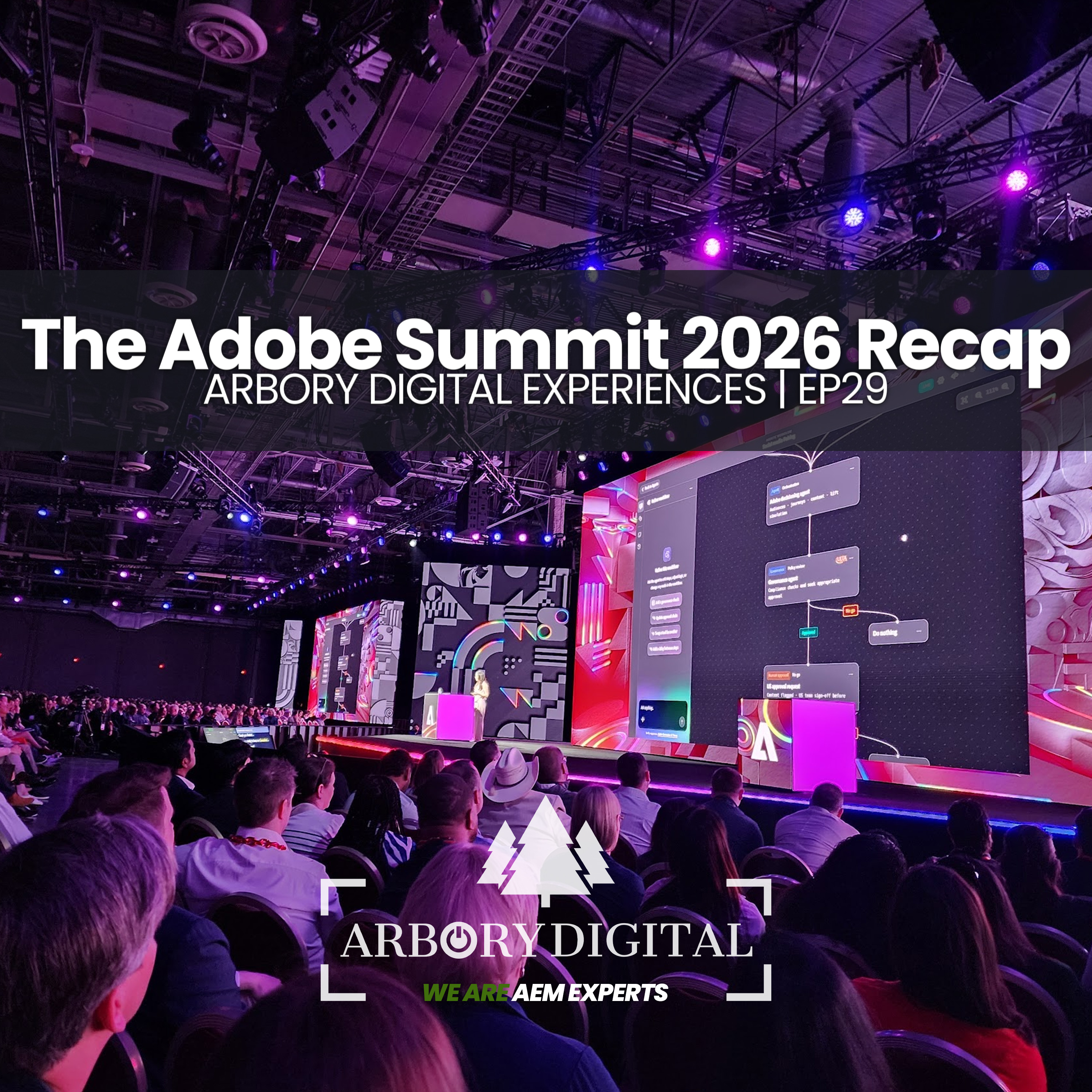
Welcome to Arbery Digital Experiences. This is episode 29 and this is the post Adobe Summit 2026 podcast.
We're still in Las Vegas and I'm Tad Reeves, principal architect Arbor Digital, joined here by Bryce Acker and also by Hank Toby cmo. We had a crew here at Adobe Summit and this was, this is exciting. This is a different format than usual is later this year than usual. This is usual versus March, right? That's right. This is right. We were usually done with this for a month so now here we are in April. But, but yeah, there's so many, so many things to go over. We're going to try to pack this up in some sort of a sensible way and, and give you an overview of what, what our experiences were summit and what things that you should go and check out yourself because a lot of the sessions are going to be online and as well as some of the lab overviews and so forth as well. So we'll try to keep it tight and try to give you an overview. Try to keep this really valuable for you.
First off, let's just go over just the event itself. There's some differences this year format wise.
[00:01:13] Speaker B: No partner day. No partner day Monday through Wednesday that sort of messed me up.
[00:01:17] Speaker A: I was thought I was flying home
[00:01:19] Speaker B: on Friday but now it's Thursday.
[00:01:22] Speaker A: That's right. That's right. And yeah, here we are on Wednesday and usually this is when the Bash is held. So and that already happened last night.
[00:01:32] Speaker B: So that was a blast. They, they did a good job this year as always.
[00:01:36] Speaker C: Yeah.
[00:01:36] Speaker A: And, and so, so yeah, so let's, let's go over just generally how this went. So yeah, Sunday was, is usually pre summit training. It was pre summit training again this time and I did not do pre summit training but we had something else that happened on Sunday which is our pre summit bike ride. So this is the second time we've done this.
[00:01:54] Speaker B: Yep.
[00:01:56] Speaker A: We put it all on ourselves last year with renting a U Haul truck and, and renting all the bikes ourselves and stuff like we out to Hoover Dam. But then this year we, we got a company ebikes and oh my gosh, that was just lovely.
[00:02:13] Speaker B: Yeah, no they were fantastic. Yeah good hosts and, and that's far the way to do it.
[00:02:18] Speaker A: Oh yeah.
[00:02:18] Speaker B: They knew what they were doing and they guided everyone through what, what a beautiful scene.
[00:02:23] Speaker C: Red rods were beautiful.
[00:02:25] Speaker A: So yeah. Oh my goodness. So. So as an overview, so we went, we took a whole tour where we had like 16 people or something like that. We went out to red Rock Canyon, Calico basin, out about 30 minutes west of, of Las Vegas proper.
And it was up 18 mile loop
[00:02:44] Speaker B: that we took ish and like 2000ft in elevation, climbed. And it was nice to have E bikes, that's for sure.
[00:02:51] Speaker A: Well, most of us had E bikes.
One member of the party did not have an E bike and I brought my own bike along. And so it was. I only found out about the route when we got there.
[00:03:04] Speaker C: Really.
[00:03:04] Speaker A: I know I didn't know the route. I didn't know what was going to happen. It was like all up to them. I was like, good, I'll do whatever. I thought we might even be mountain biking. So that's why I was trying. I was, I test, I tested out mountain bike trails on Saturday. I'm like, good, I'm ready.
[00:03:15] Speaker B: It's a good thing you got tuned up the. The day of, right?
[00:03:17] Speaker A: Exactly. And then, and then they're like, oh yeah, no, we're doing a 18 mile, 18 miles. Yeah, we're going, you know, straight up 1100ft. Right away I'm like, oh, good, good, good, good.
[00:03:25] Speaker B: He, he took off ahead of us and halfway through the incline, everyone caught up and, and then he didn't finish like dead last in the first leg. But I'll tell you what though, downhill,
[00:03:38] Speaker A: no, I got flu. I got to cook a little bit. That was fun, but that was a lot of fun.
[00:03:43] Speaker B: It was beautiful. It was wild that it's, you know, 30 minutes outside of town and just so beautiful and you just get, get off the Vegas strip and just see nature in all its glory.
[00:03:57] Speaker C: A great palate cleanser. Before the rest of the summer kicked off.
[00:04:00] Speaker A: Well, yeah, but because everybody. So we had, we had, we had. What do we have, like 5am Champs or something like that out there? We had, we had a bunch of like tons. Like almost everybody was either a developer or an architect or, or, or with, with the exception of one of the ADM champs, brought his wife along. That was, that was really great.
[00:04:18] Speaker B: Yeah, yeah, it was fantastic. Good conversations and I think everyone, it was just refreshing to do, you know, the day before summit and, and sort of clear your mind going into that.
[00:04:28] Speaker A: Oh, absolutely, absolutely.
[00:04:30] Speaker C: Yeah.
[00:04:31] Speaker A: And then the meetings with Adobe people basically started the instant that we got back from that. And, and it was just basically non. It basically did not stop until just now.
[00:04:41] Speaker B: Yeah.
[00:04:42] Speaker A: So, yeah. And as you can tell, I don't know if you guys can see this spear in the background, but we are obviously still in Vegas right now. So this is not, this is, this is not your, your, your humble abode.
[00:04:53] Speaker B: Yeah.
[00:04:55] Speaker A: Okay, good. So, so in terms of themes.
So, so last year where we were basically doing this exact same podcast. The, the whole idea was this, it was the, this whole rise of agentic AI.
[00:05:08] Speaker C: Right.
[00:05:08] Speaker A: I remember even having to define the word agentic on the podcast because it was that even, even it's, I'm like, is that a word? Is that, is that real? It was actually obviously it was a word before people were defining AI with it.
[00:05:21] Speaker C: It's amazing how far that's come in a year.
[00:05:23] Speaker A: Right to the point where everybody's expecting it. Like everybody's expecting that this is the way AI. Surprise. Yeah.
[00:05:30] Speaker B: Even in our session today, they, you know, they point out the fact that Claude code wasn't even out until I think May of May.
[00:05:36] Speaker A: Yeah, yeah, yeah, yeah. And some of the solutions that were released at Adobe Summit last year were utterly and completely rewritten before actually making it out to primetime and into, into our hands. And we're using them now. Yeah. Which is wonderful.
[00:05:49] Speaker B: Yep.
[00:05:50] Speaker A: But, but, yeah, but this year, this year it's sort of a different theme and yet you had to read between the lines a little bit. But, but Adobe these days much more is, is. Has got this idea of instead of so before they've always. So they started out and this is the start of all their products really started out much more shrink wrapped.
[00:06:10] Speaker B: Yeah.
[00:06:11] Speaker A: And now instead of saying well here's the, here's the user interface that you're going to have and look at our pretty user interface and so forth is now like this composable fabric of solutions that you can just put your own conversational interface on, you know, add your own like if you're a cloud code person or if you're a chat GPT person or you would prefer the, you prefer to talk to it or something like that. Make it so that all of their very opinionated, very super able and capable systems are all accessible on the, on the input side and on the output side for however you want it.
[00:06:46] Speaker B: Yeah. I mean they're obviously providing a lot of MCPs and a lot to come to be able to connect.
[00:06:52] Speaker A: Yes.
[00:06:52] Speaker B: Into this ecosystem from again your, your, your choice of LLM or right or Endpoint there and Even the, the APIs that are being hooked in as well.
[00:07:01] Speaker C: That's right.
[00:07:02] Speaker B: And even just in context within, within AEM itself and, and within a lot of their tools.
That's really neat to see.
[00:07:10] Speaker A: It, it. It.
It's a, it's a whole new world and if you weren't. It's one of these things too is that it's one of the reasons to go to a summit like this is that, is that after a while and after you see enough presentations and you've got, you know, whatever 15, 000 people around you that are all like huh, huh, I get it. Then, then eventually everybody you talk to, you're like yeah, of course it would be like this. Yeah. But then as soon as we go home, like this is almost the reason to bring a crew to summit.
[00:07:36] Speaker B: Yeah.
[00:07:36] Speaker A: It's because yeah. Like if you took one person and then you came home from and then you're like come home, then that one person is going to look like a lunatic.
[00:07:43] Speaker B: Yeah. Yeah. What do you mean?
[00:07:44] Speaker C: I does every right.
[00:07:46] Speaker B: Yeah.
[00:07:46] Speaker A: I don't trust that.
[00:07:47] Speaker B: Yeah, well, I think too like so we had, you know, six people on our team out here this year and just I think every one of the six is going to have a different perspective. Right. Had different conversations. And what's nice is going to be able to be able to talk through those and sort of soak up the other conversations and experiences that other people had.
[00:08:05] Speaker A: Yep.
[00:08:06] Speaker B: There's gonna be a lot of follow up too.
[00:08:09] Speaker A: There is. But I think that there's gonna be a lot of communications also to talk to people about the ramifications of this and what, what.
Because not every product is ready for this type of interface and some of them have varying degrees of like how much you can do and in some cases there was like demos and things that we saw were totally actually ready for primetime right now and we're already using them and some of them are like a little bit happy path.
[00:08:34] Speaker B: Yeah.
[00:08:35] Speaker A: And, and yes, you may be able to do things, but you don't realize that some of those demos were sped up by 20 times and, and it removed all the error, the error conditions and things like that. So.
[00:08:45] Speaker C: Yeah, the live demos.
[00:08:48] Speaker A: Right.
[00:08:48] Speaker B: Well and they were joking today. They, they what? 12x the cloud manager deployment pipeline.
[00:08:54] Speaker A: But everybody got that joke. Yeah, yeah. Because everybody's like everyone's yeah.
My cloud manager takes an hour, 15 minutes.
[00:09:00] Speaker B: Gone through that pain for sure.
You know. So honestly, just even on the labs, to me I felt like summit started out with a bang in just the very first lab that I went into and the line was out the door. I, I, they, they did it three times at Summit, which I think is the first time they've had a lab that they've repeated three times. And I know not everyone got into it that, that first session, but the very first session I went to was the Adobe Experience Modernization Agent Lab and I had to write it down because, you know, we know it as a encoder. Right.
And we've been using it for quite a little bit now and in today's world, quite a little bit like months.
[00:09:37] Speaker A: Right. Yeah, I've been using it for like weeks.
Yeah, yeah. Right.
[00:09:42] Speaker B: But you know, it was a great session and, and you could tell that it was new to 99% of the crowd. We've been able to kick the tires a little bit, which is great.
But you know, they're super stoked that a lot of migrations are going to be able to go through this to, to really onboard people into the new EDS and VA type world.
[00:10:01] Speaker A: Oh yeah. So one of my, so getting ready to takeaways on that too is one of the things that I think is most interesting about how fast you can migrate into these super lightweight CMSs, because we've got all these, these super agentic AI, any surface on the way in, any surface on the way out expectations of a CMS right now. So you can't. So having a big, heavy, super opinionated CMS that has only a couple of ways that you're supposed to interact with it.
[00:10:31] Speaker B: Yeah.
[00:10:32] Speaker A: Is just not going to get you there right now.
[00:10:34] Speaker B: Right.
[00:10:35] Speaker A: So this is one of the things that you can is a plus about this, the whole edge delivery land right now. But, but the thing that you're going to, that they get to avoid by providing a tool like this is, is what they ran into in 2020 when they came out with Frame as a cloud service. Yes, exactly. Because so cloud service came out, it was like January 2020 and everybody was like, yes, everybody's going to move to cloud service. But as it turned out, migrating a ground into on prem, you know, solution to the cloud is actually not dead simple.
[00:11:10] Speaker C: So now I've heard mixed reviews on how simple it is to get to EDS as well, depending on customers builds. I don't know what you guys think
[00:11:17] Speaker A: about that, but I don't think it's mixed reviews.
[00:11:20] Speaker C: An architect who wasn't so sure and the user, he went to that session
[00:11:24] Speaker B: and was very confused.
[00:11:26] Speaker A: Well, okay, okay, so, so let's, let's dig right into what like what would be, what would be, what would be hard and difficult about that. And that to me that ties into everything about what is like going to get like, like this would be like the skip to the end of this entire podcast takeaway of all this. Right. Which, which I guess we can get go completely out of order on this. Okay. So and that is the AIs like this. So like dramatically speed up things that took a lot of mechanical time before. Right. Like oh, we had this dialogue and this tab control or something like that. And now I need to move this into EDS and. Okay. All right. So get a couple developers, couple sprints. We're going to work on like what are my requirements? Like all this stuff. Right. And now it happens like, like in minutes you could have something like that migrated over as long as your specifications were done correctly. Right.
[00:12:17] Speaker B: One is clear too. I mean a lot of people had questions like you said. But I, when I looked around that room, they asked who, who had had exposure. 99% of that room had not had exposure to, to that. Yes. And that's the migration agents AUM code
[00:12:31] Speaker C: I was surprised by.
I didn't think the EDS messaging would be so forward and on everyone. It seemed like all the people that we were around and hanging out with came to the backyard. It was all like regular to them. But I figured that might just be the in crowd.
[00:12:44] Speaker A: Yeah.
[00:12:44] Speaker C: And then going out into the summer Broad summit broadly and hearing everyone also talking about it, even people who weren't working on AM were talking about it.
[00:12:52] Speaker A: Yeah.
[00:12:52] Speaker B: It's clearly to your point though. I mean I, I think they're providing those tools to be able to on ramp so much easier. Exactly. And they are working and obviously we're working with them right now. And, and, and it's a lot smoother than it was a year ago.
[00:13:07] Speaker A: That's right.
[00:13:07] Speaker B: To onboard.
[00:13:08] Speaker A: And it's not a be all. It's not a be all end all. It's not even meant to be a
[00:13:11] Speaker B: be all end all.
[00:13:11] Speaker A: But, but the fact that it is a, it is a massive accelerator is what it's all about. It basically is going to take a lot of the pain out of it. But what it doesn't remove is it doesn't remove the overall job of good architecture, of intentional planning of how something's going to happen. Which that's like this takeaway point that Jensen had in the keynote with Shantanu at the very beginning.
[00:13:42] Speaker B: Right.
[00:13:42] Speaker A: So, so Jensen Huang, the CEO of Nvidia, was talking with the Adobe CEO Shantan and one of the points and I actually tried to write it down word for word. Actually what he said was one moment please recall is very important to us.
So he said so it's the purpose versus the task that needs to be separated and have in having having somebody who understands the overall purpose and, and, and, and what are you trying to do? You're not going to remove like the, like this, this all the, all the doomer stuff that the, that the anthropic CEO keeps coming like oh, it's going to remove all the white collar jobs, they're all going to die. Like it's, that's not it.
[00:14:30] Speaker B: Yeah.
[00:14:30] Speaker A: That just the people just get to move up the stack a little bit if they're willing to move up the stack.
[00:14:35] Speaker B: If they're willing to be. I watched the story on, on a lot of sessions, thought is that, that it's, you know, the agents doing the work, but the governance being human controlled and enabling the creativity and the thought and, and again the architecture and building and designing and, and, but so much quicker to ideation. Right.
[00:14:54] Speaker C: And I think.
[00:14:55] Speaker A: Right.
[00:14:55] Speaker C: The sentiment around that realization last year compared to this year is completely different.
[00:15:00] Speaker A: Oh 100. Yeah.
[00:15:01] Speaker C: Last year there was like maybe like gasping and they were talking about these regions coming in this year.
[00:15:06] Speaker B: You can tell everyone's warmed up that it's right here to stay.
[00:15:09] Speaker A: Yeah. But also I think, I think people have a little bit more of an understanding of what feeds them. You know what I mean?
And the fact that there's just the
[00:15:15] Speaker B: bigger concept of what they are at this point.
[00:15:18] Speaker A: Yeah.
[00:15:19] Speaker B: And I was, I want to hit on this too that one of the sessions Sarah Zhu put on, they talking about the mcps and really it's the AI registry that Adobe's putting out.
[00:15:29] Speaker A: Yeah.
[00:15:29] Speaker B: She had the analogy that really stuck to me and I felt like helped a lot of people. It was a kitchen analogy but with, with agents and MCP and skills.
The agents being the chef, the MCPS being sort of the pantry and the skills being the recipes. Right. And I thought that was a really, really good analogy. It's, it's not perfect clearly but it's a good way to wrap your head around some of those concepts there.
[00:15:53] Speaker A: Absolutely, absolutely. And if you don't give, if you don't give some, some. One of these agents and, and the various AIs that are behind them enough instruction on what you want, then it's just going to be a fire hose just going to kind of going all over the place and you're going to get whatever you get.
[00:16:09] Speaker B: Yes.
[00:16:09] Speaker A: And you might get your AI slow. And that is the, the, yeah, the, the website migration equivalent of, of awful chat GPT slot. Yeah. So. Yeah. Yeah, for sure. So there was that. So there's that whole, that whole.
That was, Was it Marcus? No, it was Carl and Gabriel's. Am Cuter Lab.
[00:16:32] Speaker B: Yeah, that was it.
[00:16:32] Speaker A: They kicked this up.
[00:16:33] Speaker B: They did it three times, I think. They did.
[00:16:35] Speaker A: Yes, exact. Which is the only time in Summit history that a lab's been done three times. And it was packed. It was that every time.
[00:16:41] Speaker B: And it should have been, honestly.
[00:16:42] Speaker A: Y. Exactly. Well, because people need to actually understand.
[00:16:45] Speaker B: Yes.
[00:16:46] Speaker A: The difference right now. This is. This is not your father's Oldsmobile on when it comes to website migrations.
[00:16:52] Speaker B: Yeah. And we've been using it for a little bit now. And, and, and it is very intuitive. I mean, so in a, you know, customer example that we're going through right now and we just sort of pointing
[00:17:01] Speaker A: in at a site, it's.
[00:17:03] Speaker B: It's crawling the site, it's. It's templating things. It's building out sort of the look and feel, it's building out the blocks, it's doing the content import scripts. It's run in, running and iterating through some of that content to. To improve on the scripts.
[00:17:16] Speaker A: Right.
[00:17:17] Speaker B: In an iterative fashion.
[00:17:18] Speaker A: Right.
[00:17:18] Speaker B: And, and you know, that's again, just been a couple of months and that's just going to improve and improve.
[00:17:23] Speaker A: It's going to improve. And it's clear also that an uneducated hand operating a tool like that is going to create a site that is totally unmanageable.
[00:17:33] Speaker B: Yeah.
[00:17:34] Speaker A: But an educated hand running something like this is going to be. It's going to be like the difference between somebody who's never operated an excavator.
[00:17:41] Speaker B: Yeah.
[00:17:41] Speaker A: You know, trying to just start going and doing stuff and they're going to end up taking somebody's car out or something like that and then somebody who actually knows what they're doing.
[00:17:48] Speaker B: And again, it's, it's still early in that tool's development, but already like in context in, in your workspace individually. So user that logs in has their own workspace. You see the site being built and can like modify that or have it redo that and talk through it in a communicative manner and it shows the content and then you can push the content directly into your repository and the code. And similar to like a GitHub, it's highlighting the changes in your code and you can commit that directly into your branch.
[00:18:17] Speaker A: That's right. That's right.
[00:18:19] Speaker C: Tad, you mentioned the keynote there.
Do you want to linger on that a little bit? Like, what do you guys. What did you guys think of the first Keen Air? Is that probably these names, dude.
[00:18:29] Speaker A: I mean, there's obviously big names. I mean, and I. So the one that was the most impactful was, was, was Shantanu and Jensen because Jensen is just, I mean, I mean, hey, it's funny because he kept kind of talking over Shantanu. It's like two CEOs trying to both be CEOs at the same time.
[00:18:44] Speaker C: Wonderful.
[00:18:44] Speaker A: Yeah, that was actually quite wonderful. But, but the fact that they were both talking and, and, and Jensen kept, he had, he had a bunch of amazing like sound bites that he, that he came out with. So, so there was like, like you talking about the one on, on radiology.
[00:19:01] Speaker C: Yeah. But what I wanted to say about those sound bites is I was listening to a podcast earlier this week with Jensen.
[00:19:07] Speaker A: Okay.
[00:19:08] Speaker C: Same bites they were worked okay fine.
[00:19:13] Speaker B: In the day one it was a little bit more flat to me than the day two. I actually enjoyed PNG's CEO. Yes.
It's wild to me that they both went to the same high school.
[00:19:24] Speaker A: That is kind of wild. How crazy. Sh. Shantanu and the PNG CEO went to the same high school and, and, and the PNG CEO looked up to Shantanu because he was four years older. Yeah, he's a, he's a big kid. I want to be like him.
[00:19:36] Speaker B: Right. But yeah, that, that's, that's really wild. It's, it's neat to see those, those synergies right there and where people come, you know, from Mumbai and are. Are leading two major corporations in this
[00:19:48] Speaker A: but having something with that many brands, the number of brands that, that he's got to keep track of. To me that's like anytime that I've done an AM site. Oh yeah, like oh yeah. I've got a, I've got some multi site manager stuff that I got to do. I got to do a couple of brands. Well, how about png?
[00:20:03] Speaker B: Yeah, they've been around so long. I mean that, that story of. And I had actually heard it once before but I know everyone I talked to had not heard that. But they created the soap opera.
[00:20:12] Speaker A: Right.
[00:20:13] Speaker B: Basically for marketing, right?
[00:20:14] Speaker A: Yeah, exactly.
[00:20:16] Speaker C: It's really wild to display their, their kitchen goods.
[00:20:20] Speaker B: Yeah. Basically to run the ads to, to, to Truman Show. Honestly Housewives at the time.
[00:20:25] Speaker A: Right?
[00:20:26] Speaker C: Yeah.
[00:20:27] Speaker A: But there's a couple so in and amongst those keynotes, especially the day two keynotes where they got a little bit more into the guts of, of things too. There's a bunch of new products that got, that got announced.
Some of those were repackaging existing so not really existing products but, but things. So there's reorganized reorganizing things under, under umbrellas because We've got this whole CX Enterprise sort of sort of umbrella that
[00:20:51] Speaker B: how do you bring everything into the
[00:20:53] Speaker A: fold and exactly that. A bunch of the agentic functionalities kind of bundled underneath and then also exposing this whole C. CX Enterprise co worker which is kind of like a co pilot ish kind of a. Both a UI but also just, just a skill and MCP ish type skill that you can go and.
[00:21:13] Speaker B: Yeah.
[00:21:13] Speaker A: And talk to and basically have. Have all these different ways to get data in and get data out. Because none of the, the marketing problems are. Are single faceted problems. Like you know, oh, I've got, if I get a signal like this then I want to, to take this action. I want to make this new content.
I want to know that this, that these people are, are not up right now. So they can't approve this content that I just went and created on your behalf.
[00:21:39] Speaker C: Right.
[00:21:39] Speaker A: So I got to send it to the UK team who might look at it and then I'm going to activate it in these ways and then store the data in this backend way.
A lot of that orchestration is like just. Yeah.
[00:21:49] Speaker C: It's across a bunch of different tools.
[00:21:50] Speaker A: It's a ton of different tools. Right. Some of them aren't even owned by Adobe at all.
[00:21:54] Speaker B: Sure.
[00:21:55] Speaker A: Right. So yeah.
[00:21:56] Speaker B: Which is where that MCP layer can come in and. That's right. Reach out to other sources.
[00:21:59] Speaker A: That's right.
[00:22:01] Speaker B: And to your point like there's parts of it that are automated parts of it the agent's running and then other parts where it's waiting for approval and waiting for you know, human either in the UK or somewhere else to, to put eyes on it and say yep, we're good to go.
[00:22:15] Speaker A: Right. And this is where I think some of the, some of the, some of the keynotes came back to this a couple times and Jensen even mentioned this one of the times we was talking about how he was the first, he was, he had the first signed copy of, of Creative Suite 3.
[00:22:30] Speaker B: Yeah.
[00:22:31] Speaker A: From Shantanu like at the time boxed, you know, shrink wrapped and everything like that. But he's talking about how they, you know, they still use a ton of Photoshop and things like that. It doesn't make these, these skills go away, it's just it kind of moves people up the stack. What I kept thinking of is, is Photoshop itself, right. Like so, so, so if you're going to be like a Photoshopper and so I'm talking to Frank because Frank is the one videoing back there price Photoshopper but, but so like when you, when you're doing Photoshop, like, you used to have to have like a Photoshop machine that could like run Photoshop, like.
[00:23:04] Speaker B: Well.
[00:23:04] Speaker A: Right. And then, and then when you were.
But a lot of times, like, you'd run a filter or you'd run some, some, some new set of actions, something like that. And you have to wait. You know, you're watching the bar slowly go across. You're like, man, I wish I had a faster Photoshop machine. Right. And it was all based on like, you're all these bottle. All these mechanical bottlenecks or, or also like, like, okay, I gotta punch out, I gotta punch out this, this the background of this girl who's got flowy hair, and you're sitting there trying to quick mask around all this and you're like, you know, and if you're like me, you're really awful at masking. And so you're like doing a crappy job.
You already had the thought of exactly what you want to make.
[00:23:42] Speaker B: Yeah.
[00:23:43] Speaker A: Like, like yesterday. Yeah. And you're still working on executing on the thought that you are. You already visualized the full thing of what you want.
[00:23:53] Speaker B: I mean, to a degree. In a lot of those scenarios, people almost lose the thought because it's taken so long too.
[00:23:58] Speaker A: Right.
[00:23:58] Speaker C: Or they don't have the technical expertise to express the thought.
[00:24:01] Speaker B: Yes.
[00:24:02] Speaker C: They don't know how the tool works.
[00:24:03] Speaker A: Really. Yeah.
[00:24:04] Speaker C: Right.
[00:24:04] Speaker B: One example was.
[00:24:05] Speaker A: Yeah.
[00:24:05] Speaker B: I always asked my friend to, to do the Photoshop for me because I'm not good at the tool. Right. And now I can just erase the person from the image myself.
[00:24:14] Speaker A: Right, right, right. But that's, that's the thing too is like, if I, if I, when I have a tool, like right now in Photoshop, I've got a thing that I can go in there and there's a thing that. This is a new Adobe Firefly stuff working. Just go and punch out the background for me.
[00:24:28] Speaker B: Yeah, right.
[00:24:29] Speaker A: Does that, Is that, is that cheating now? Like, is. Are the humans out of it now? Like, no, I still had the exact idea that I want. I still visualized exactly the effect that I want.
I just didn't have to go through all the mechanical steps. And I feel like that's.
[00:24:43] Speaker B: Yeah.
[00:24:44] Speaker A: What's happening in marketing, we get so
[00:24:45] Speaker B: many iterations and variations. Choose what vibes with.
[00:24:48] Speaker A: Yeah.
[00:24:48] Speaker B: Most.
[00:24:49] Speaker A: Yeah. So, but I feel like that's what, like with, with, with all the agentic stuff, you just go, well, is this. Are humans out of the mix now? But that's the One thing that Adobe keeps bringing up again and again, it's like humans are at the center.
[00:25:01] Speaker B: Yeah, they're the audience.
[00:25:02] Speaker A: They are the. Yeah, they're the audience and they are the creators. And you're just trying to, trying to empower a creator who had an idea.
[00:25:09] Speaker B: Yep.
[00:25:10] Speaker A: And they want to get something done.
[00:25:11] Speaker B: Yep.
[00:25:12] Speaker A: Anyway, I just kept think of that again and again.
[00:25:15] Speaker B: Yeah, for sure. Honestly, like, you know, we can hit on that. But, but Sneaks really made me think about that a lot. Like so many of those. Those demos.
[00:25:24] Speaker A: Yes, yes.
[00:25:26] Speaker C: Okay. Yeah.
[00:25:26] Speaker A: So fine. So, so, so let's just get right into. Okay.
Summit Sneaks. So every year they do a whole set of sneaks where, where they get a bunch of engineers. And for anybody who doesn't isn't familiar with the format.
Yeah, but so, so we have. So they usually have a bunch of engineers that get on. On the seven this year. These are people who are not presenters. These are, these are nerds. My favorite. Right, Right. Yes. I love that they're just nerds.
[00:25:51] Speaker B: The comedians dealing with the.
[00:25:54] Speaker A: Absolutely.
[00:25:55] Speaker B: But the deep level expertise people that, that really just want to do their demo, not be interrupted.
[00:26:02] Speaker A: Yeah, but, but then we had. Was Eliza Schlesinger. Schlesinger. Oh my gosh. She's probably going to log onto the. I hope she logs on the podcast and then eviscerates me for butchering her name. Yeah, but, but she like, she's like, like got the sharpest comedic wit. So what they do every year is they have somebody who's like a comedian or a celeb get up there and the, these nerds have to go and present their crazy like, mad scientist thing to whoever the celeb is and get them to understand it. And so of course she's just like, oh, it was, it was perfect.
[00:26:33] Speaker B: It was perfect. I love the WrestleMania theme this year too.
[00:26:36] Speaker A: It was WrestleMania theme theme the whole time. Good.
[00:26:37] Speaker B: Because when we showed up this, this past weekend that Vegas was just chock
[00:26:42] Speaker C: full of ready for it.
[00:26:43] Speaker B: Oh, yeah.
[00:26:43] Speaker A: Oh, yeah.
[00:26:44] Speaker B: Everyone was pumped for WrestleMania and wearing their T shirts.
[00:26:47] Speaker A: Oh, yeah, that was awesome. But yeah, but there's. There's seven different ones and it's. What's funny is that in previous Summit sneaks, I've been, I, I look at some of the stuff that people create and I'm like, that's not real. Like, that's not. Well, right, right.
[00:27:03] Speaker B: Yes. Yeah.
[00:27:03] Speaker A: It's vaporware or it's total vaporware. And it's not actually going to happen.
[00:27:07] Speaker B: It's not Happening live.
[00:27:08] Speaker C: But every one.
[00:27:10] Speaker B: Yeah, you know, they, they can't do it in real time all the time because it is, is condensed. Yeah, unlike.
[00:27:16] Speaker A: Unlike Rockstar Live, which is all live.
[00:27:18] Speaker B: It's all.
[00:27:19] Speaker A: Yeah, like. Yeah, yeah, yeah, exactly. Real life engineers that we know sweating bullets. Yeah.
[00:27:25] Speaker B: And that to me was the most impressive thing. I think where you're going with is that at the end of Sneak, they're like. And these are all live and you can go toy with, toy around with them right now.
[00:27:34] Speaker A: Precisely. Yes, you can toy around with them right now. And just as an example, what was it called? Project Site Leap was the name of one of the sneaks last year, which is AEM Coder, which is the thing that we were just leading off talking about. That is live right now and we're using right now.
[00:27:50] Speaker B: Yes.
Yeah. Actually one of the sneaks this year was something that Cedric hit on this year as well, which is audience of one.
[00:27:58] Speaker A: Right.
[00:27:58] Speaker C: Audience for one. Stuff is so wild. That's like change. It's going to change how companies market to people.
[00:28:05] Speaker A: Yes.
[00:28:05] Speaker C: So basically the idea is that as you're scrolling through a site, the site is learning what your intent is on the site and then it'll start serving you customized AI generated content based on what you're actually looking for, based on
[00:28:19] Speaker B: your brand, based on your products, based
[00:28:21] Speaker C: on the information, based on what that user's intent is.
[00:28:24] Speaker A: Right, yeah.
[00:28:26] Speaker C: That changing how the Internet works for. In some cases.
[00:28:29] Speaker B: Yeah, yeah, that's convenient.
[00:28:32] Speaker A: Evidently some of that, some of that that was shown is actually in the wild working right now.
Yeah, I mean, I know.
[00:28:40] Speaker B: Well, they showed it sneaks and, and I mean, and Cedric demoed that a little bit too in his presentation.
[00:28:44] Speaker A: Yeah. It's not like just something that is proposed possibly for the future. This is like something that's happening right now.
[00:28:50] Speaker C: Are those two products parallel efforts or are they two separate people going for the same idea? What you.
[00:28:56] Speaker B: I think it's the same thing.
[00:28:58] Speaker A: So, so, so he.
[00:29:00] Speaker B: So Cedric actually did a, a post on LinkedIn on that, some talking about that. And so then, then he, he had a very similar. It was slightly different demo, but similar concept, similar tooling. So I think it's the same thing.
Yeah, yeah.
[00:29:17] Speaker A: Absolutely wild.
[00:29:17] Speaker C: It's going to be a fun new world for marketers, I think.
[00:29:21] Speaker B: Oh my gosh. Yeah.
[00:29:22] Speaker A: Yeah.
[00:29:23] Speaker B: That definitely got all their creative juices flowing.
[00:29:27] Speaker A: So there's the marketers, so there's another audience that we haven't really talked about and that's authors and so, and so, so One of the. This is. I mean, fine, fine. Two. Two of my besties went and ran this because Marcus Hawkin and. And Chris Moore ran the. Ran this vibe coding and AAM author and interface. And it was a fabulous session. But what to me, what it illustrated is so I've been a part of for the last 15 years so many sprints where the only thing that people were tackling sprint over sprint is authoring user interface fixes. Yeah. Of like.
[00:30:06] Speaker B: Oh yeah.
[00:30:06] Speaker A: So I says they have to go and they pick this and then. Oh yeah, we're just trying to make a new tab so the author can fill out this field and that's. Oh, we tested it, but it broke the authors. We had to roll it back like all this nonsense. Right. That takes weeks and weeks and weeks and weeks to get something done.
[00:30:20] Speaker B: Yeah.
[00:30:21] Speaker A: And the entire lab full of people.
[00:30:24] Speaker B: Yes.
[00:30:25] Speaker A: Like kind of just took from just a. An idea from ideation to, to real life.
[00:30:31] Speaker B: Yes.
[00:30:32] Speaker A: During like. And the vast majority of people in the lab got it done.
[00:30:36] Speaker B: Got done. Understood the concept.
[00:30:39] Speaker A: Right.
[00:30:39] Speaker B: Built a whole app that then also deployed a page and then we're able to then hook into that page and iterate on that page the content.
[00:30:49] Speaker A: Right.
[00:30:49] Speaker C: I. I have very limited technical and authoring experience and I got it done. Just. You got done to everybody.
[00:30:55] Speaker A: Sweet. Yes. It.
[00:30:57] Speaker B: Yes.
[00:30:58] Speaker C: In my mind it's like I used to have to rely on a bunch of different people to get any of that done.
Could just do it myself now.
[00:31:05] Speaker B: Right.
[00:31:06] Speaker A: Right.
[00:31:06] Speaker B: Yeah.
[00:31:07] Speaker A: Which the takeaway that I think almost anybody should have from. From that is that is that you shouldn't have to live with an arcane authoring experience.
That, that, that. Because I've been a part of too many, too many marketing orgs where highly technical or only highly trained authors can do a bunch of different operations. Because, because if you can't trust the
[00:31:29] Speaker C: business users, it creates a giant bottleneck.
[00:31:31] Speaker A: Right. They're like, oh yeah, well can't. Can't the business users do this? No, business users can't do this because they have to. No how to do this. And this thing with content fragments and this thing because they might break UI is complex. The authoring UI is complex and oh, but. And they can't add too many things. They can't nest this or else it'll crash the entire author and bring it down. Not like we've ever seen that happen. Right.
Now, I'm sure we've never seen that happen more than 10 times in a, in a week. But, but, but just the fact that Anybody can now take a given problem and as if it really comes down to how cleanly can you articulate the problem.
[00:32:10] Speaker B: Yeah.
[00:32:11] Speaker A: And if you understand the problem that you're trying to solve and you understand the array of solutions that you possibly have, and you've talked that over with your devs and architects, like, okay, where can we store this? Okay, good. Is it sensible to store this? Yes, it is.
[00:32:25] Speaker B: Great, good.
[00:32:26] Speaker A: I'm going to make an authoring UI to do that and then even a technical project manager could, could give a crack at it.
[00:32:32] Speaker C: Right. But I do think, and you touched on this earlier, it's really important for environment to be set up cleanly and correctly.
[00:32:40] Speaker A: Yep.
[00:32:41] Speaker C: Brand guidelines. Yep. Me and Frank have been talking about that a lot the last couple days. We need to get that set up on our site stat, because otherwise you have all these different people uploading content.
[00:32:52] Speaker A: Well, just like here we go.
[00:32:54] Speaker C: Because they're enabled to do so. And so putting proper guide rails on what can go out and how it needs to look.
[00:33:01] Speaker B: Right.
[00:33:02] Speaker C: Is going to be massive too. And they're going to need experts to help configure all those different pieces.
[00:33:07] Speaker A: Absolutely.
[00:33:08] Speaker B: They harped on that. Right. I mean, brand safe brand guidelines. I mean, be able to put those checks in place and then even training some of the stuff on your brand so that as the agents are generating stuff, they're generating it based on the history of your brand, based on your already approved assets.
I mean, that's super powerful just in and of itself, let alone then checking it to make sure that it meets all the guidelines afterwards.
[00:33:37] Speaker A: So there was that. I was blown away by the implications of that. I don't, I think that's under, under underappreciated, the, the, the number of things that you can do for authors at this point.
[00:33:48] Speaker B: Yeah.
[00:33:49] Speaker A: A piece of that though is, and this is, I think, something that still terrifies people for the most part is the idea of a conversational interface with an author, like, oh my gosh, what will people do now?
[00:34:02] Speaker B: Right.
[00:34:02] Speaker A: But this is, again, so this is the whole idea of Adobe now for almost every interface for an AM author, for document authoring, for cloud manager, for so many different things. You can now expose an mcp, which basically Model context protocol, basically gives one of these LLMs the context that it needs to be able to do something. Because you can't just go and chatgpt and say, hey, you know, yo dog, I'm running AEM on my website, can you go and update the chatgpt? I don't know what you're doing. But if you give it an MCP and you log in and say good, here's my authentication. And this thing now has new. Now now has authentication credentials to, to my backend.
[00:34:46] Speaker B: Good.
[00:34:47] Speaker A: Now here are the skills that I could invoke.
[00:34:49] Speaker B: Yep.
[00:34:49] Speaker A: And you could say good, here's, here's my problem. I've got five pages in my about us that have outdated imagery. I have the new imagery that's in the Content Dam July folder. I want you to update all the heroes that are on that with the imagery that's in Content Dam and I want you to preview them. And I want this in a branch. The branch is called block go.
[00:35:09] Speaker B: Yep.
[00:35:10] Speaker A: And then you could set it to, to doing that and it goes and does this in a, in a, in a controlled environment and then send it up there
[00:35:19] Speaker B: right into your point there. A couple people had questions actually in a number of different sessions like well now I'm concerned is this hooked up to production? I might get like blow away all my production content. How safe is that? And in the, the traditional AEM aspect, you know, they have it set up where it creates launches. So that's not actually you know, live content. You have to then go in and approve it and bring that launch in. You know, similar to like translation projects or other things. Right. And then in da where it's even possibly staged locally and yeah you can just see it locally from your local computer. It's not actually even the content repo yet. The whole like it's still with your production content and running with your production level code and the ability to then snapshot as well pages within that. So you still have that, that assurance that you're, you know, you can run this agent, you can, you can vibe code or your create the content, you know, with these new tools and you know, be relatively assured that you're not blowing away your whole production website.
[00:36:24] Speaker A: That's right. That's right. And I think that's one of these things where, where it makes command line tools cool again because if you have well understood command line tools like this that it's not even necessarily that you need to know all of the command line tools. Yeah. Is it? They're out there and then the, and the LM knows about this and this is one of the ones too where back to things that Jensen was saying is that, is that previously like with take Photoshop as an example like, like I've been using Photoshop since 1993 or something like that. I still know probably chicken 4% of Photoshop. Yeah, right. Like I, like there's so many things that I just don't. I can do what I can do, I know how to do. Like there's certain things I could find, masking, punch outs and stuff like that and a bunch of layer stuff like fine, I'm okay with that.
Some of the other more advanced stuff, I just don't know. Right, but if you give an LLM,
[00:37:21] Speaker B: like, but if I, you know it exists.
[00:37:22] Speaker A: But I know it exists. How do you know it exists? Exactly. And I have a concept of what I want it to do and I know it can be done using the tool. I'm not telling it to, to, to go and, and like you know, make my kids pancakes right now, you know that's not one of Photoshop's capabilities. Right, but if I know what it can do.
But if you have an LLM and if you have an MCP and you basically say here are my CMS's capabilities I have. So let me tell you all its capabilities. Good, so now you have all its capabilities. So now here's what I'm trying to do. And the LLM can say good, well, well I could, I'll use this capability to. Oh, I forgot that existed. All right, well good. I'm glad you did that, Mr. Elway. Yeah, yeah, so, yeah, so that, that sort of thing is, is, is, that's just, yeah.
[00:38:03] Speaker B: Underappreciated. So much more knowledge about the, the, the tool set and the APIs than, than most people do, except for very deep level experts.
[00:38:12] Speaker A: That's right. That's right. It. So, so it doesn't obviate the need to be a deep level expert.
[00:38:18] Speaker B: Right, right.
[00:38:19] Speaker A: This is, this doesn't mean that everybody can just dumb down their understanding of, of content management systems and how all this stuff works. It means that you have to have people really understand how everything works and connects. But once they do, it takes the mechanical time of how much time do. Are you now going to go spend, you know.
[00:38:35] Speaker B: Well, in those. Again, those level experts are the ones that are putting like gluing all the pieces together and building Even future new MCPs to enable everyone to be able to use these and. Right. You know, safe, effective and quick manner.
[00:38:49] Speaker A: Yep, that's right.
So more future stuff. So there was also Cedric and Horesh's session, which that was, that was one that I had been looking forward to this entire time and they didn't disappoint because there was a lot. It was, it was a lot.
[00:39:03] Speaker B: And he did it live too.
[00:39:05] Speaker A: He did it live also? Which is great, I really appreciate that.
But things, all kinds of things. This like experienced production agent, another one of these agents, there's all these agentic capabilities that are out there. Like literally grabbing an annotated PDF where you say fix this, handle that, you know, none of this new photo. Right. Where somebody literally scrubbled all over some PDF feed that into this agent and it says good, I'll use this skill to do this. Use this skill. Good preview.
[00:39:36] Speaker C: Go.
[00:39:37] Speaker B: Yeah. Or from a figma.
[00:39:38] Speaker A: Yep.
[00:39:38] Speaker B: Or for one of my other labs, it was a hand drawn form.
Yes, he hand drew the form and the LLM understood the hand drawing and I've actually done this. So I'm a huge fan of handwriting a lot of notes. I actually remember everything better. So like when I'm in customer meetings or technical calls, I'll actually handwriting things and with my cloudbot currently like I'll just send it a snapshot and it can read it and parse it.
[00:40:07] Speaker A: Right.
[00:40:08] Speaker B: And so they did that with again, it's similar to a figma, but it was a hand drawn form.
[00:40:13] Speaker A: Right.
[00:40:13] Speaker B: It took that generated the form.
[00:40:15] Speaker A: That's right. And then, and in some cases too where you were. So they've got, they've got a bunch of these agents that they talked about last year, but there wasn't this like kind of real way to stitch some of these capabilities together. Like there's this governance agent which I always thought, okay, that's a, that's a neat thing in, in isolation. Like okay, that's neat. Right. Where are you gonna go? You know, send it like as the governance police, like I was trying to think of the use case. But when you have agent to agent agent, right where you say good, here's this production agent, but here's this other governance agent is going to say, you're my brand guidelines. I've articulated my brand guidelines. Here's my style guide. Let me, let me, let me point you at my style guide website that I've got because almost every big brand's got either a brand website or a big set of PDFs or something that, that articulates all their brand guidelines. I always use this color. Never use this logo in this way. No, no drop shadows like whatever, whatever the, you know, color. This here are the fonts. Like all this stuff that nobody ever remembers. But an LLM will remember that.
[00:41:12] Speaker B: Yep.
[00:41:13] Speaker A: Right. And so then you can say good, use this and flag if anything is, is. Is against brand guidelines. You know, go sure. And then if somebody can say good, I'll, I'll implement a bunch of the stuff on your scrawled notes, except for this one because it's against brand guidelines. Yeah, like, whoops. Yeah, I would have missed that.
[00:41:27] Speaker B: Yeah, yeah, yeah.
One of the sessions I really liked was Bertrand's and, and Brian's. Yes, I thought that was fantastic.
[00:41:36] Speaker A: Yeah.
[00:41:37] Speaker B: You know, one. And I think something that we'll be going to be talking about here for, for a bit and I, I captured it was. It was when in the slide deck. Yep. But they, they really validated, you know, where we've been going in a lot of our stance with our customer conversations. Right. And, and so traditional aim is here to stay. They're building a lot of AI tools and a lot of bells and whistles for that. But the quote was Adobe's recommended direction for new projects is EDS and da.
[00:42:03] Speaker A: Yep.
[00:42:04] Speaker B: And that was, you know, clear as day right there on the slide. And, and I thought that was the, to me, that was the first time we're really, you know, publicly coming out and saying that that was, that was fantastic to see because I totally agree with that.
[00:42:17] Speaker A: Oh yeah. Especially since, you know, we, we've had our, we, we, we've been through all of the, the, the discussions about, you know, what is the future of all this. And you know, we, we've, we have strong opinions. Sure, sure. We've been working with people and there's
[00:42:31] Speaker B: lots of different use cases, lots of different use cases and positions where people at. Are at in their journey with aem. Right.
[00:42:37] Speaker A: That's right.
[00:42:38] Speaker B: Obviously we've been in this space for so long, going back into the day, CQ days. Right. Pre Adobe acquisition. And so there are repositories out there that, you know, are working, you know, keep it as is. That's great.
But you know, the key there being new projects. But, you know, I think in our opinion, a lot of these migrations, as you're rethinking things to be able to hook into all these tools. But I'd say the one other thing that's not really you AI, it's more automated that they're rolling out that I think is going to be a big hit is Canary deployments.
[00:43:10] Speaker A: Yeah, that was, that was okay. That's, that's, that, that's one of these ones. It's like, I think we first asked for that a really long time ago.
[00:43:18] Speaker B: Yeah, I mean, we've been doing Canary.
[00:43:20] Speaker A: We made our own stuff back at. Oh, sure.
[00:43:22] Speaker B: Yeah, we've been doing it for a long time. We've been doing that in, in the concept of other customers, not even AAM customers. I mean Canary deployments or, or even sort of blue greenish. Although Canary is. Yeah, slightly different. Yeah, it's been around for a bit. But to put that into the Canary
[00:43:35] Speaker C: deployments or where you're launching instances of the site and just sending some traffic to it.
[00:43:39] Speaker B: Yeah, exactly. So essentially, so you have a new code or whatever you're releasing now into production.
You, you only release it to maybe 10% of your customers and you make sure it works.
[00:43:53] Speaker C: Or 10% here, 10% here, 10% here.
[00:43:55] Speaker B: Yeah, yeah. However that looks. And I don't know what, how the configuration is going to be with this and I think it, I don't know if it's exactly released yet or they're saying they're going to be released here within the next month or two.
[00:44:05] Speaker A: What they said is, is that it's a, it's command line. So, so Cloud Manager has now an MCP that you can talk to, but it's also had a whole AIO COI that you could go and talk to it and give a commands. So it's not in the, it's not in the GUI yet.
[00:44:21] Speaker B: Okay, but it's, but it's, it will be.
[00:44:23] Speaker A: But, but, but it's, but it's in the cli, right?
[00:44:24] Speaker B: Yeah, evidently. But to your point, yeah, like the purpose of it is that you might have been able to validate your code in your dev environment and your staging environment. You feel relatively certain about that. But maybe there's third party calls that you're making to either databases or to other, other systems or, or, or, or what what have it. And you cannot test that in your Dabber staging environments because they're hooked up to very common other third party staging environments or other sandboxes. And so really you can't actually validate until you get to production that you know, what you just built actually works and works with the other systems production environments or you know, whatever the case may be. There's, there's lots of, there's a myriad
[00:45:06] Speaker C: of two way to test all sorts of new things.
[00:45:09] Speaker B: Exactly. So you can release it to again, you know, let's say 10% of your, your global customers.
But you can put it's I think a query string or header parameter. Basically, you know, says, you know, canary equals true and, and thus be able to, to test this. Because that was the other issue that people used to have initially is like how do I know if I'm hitting the Canary or hitting the, the, the old version of my production. And so you can force it where you're hitting the canary, validating your scenarios. And I'm sure there's going to be some automated checks too. Like we do that with our canary deployments where, you know, there are some automated checks to, to test and if they fail those checks, it'll roll that back and so you've Only affected Possibly 10% of your, your customers and roll that back safely. But if everything's good to go, okay, now we're going to say this, this new build's good and push that out and roll that out to the 100%.
And now it's in production.
[00:46:05] Speaker A: As far as I know though too, that, so that's a, that's the aim as a cloud service thing that doesn't necessarily have. Yeah. So that doesn't necessarily affect the, the edge delivery population. But it's, but it's, it's. It's massive for, for those ones that are on the, on the amjcr.
Um, so one of the other. So there's a lot of other things that, I mean, I guess we could, we could, we could probably talk through our sessions for quite some time and if you got more that you want to. Want to hit on, we probably can. But one of the things that I want to talk through is, is a lot of the non session value.
[00:46:36] Speaker B: Oh my God.
[00:46:36] Speaker A: That I was getting of summit this year, which was so it's, it's one thing. So I've been to summits a bunch of times where I didn't. I, I was just going to summit. Yeah, right. And then when you go to settlement and you sit down and you're just. Basically, it's just like the Maxel ad, you know, where, where the. You guys just getting his face blown off by the tv.
[00:46:55] Speaker B: Yeah.
[00:46:56] Speaker A: Or the, the speakers.
So you just feel like that the whole time we're just like, what am I experiencing here? Right. This year I had a lot of very specific problems and things that I'm in the midst of going through. So. So it was, that's one of the reasons I feel like it was just super targeted. So there were like, gosh, so much access to really great engineers.
[00:47:17] Speaker C: I'm always surprised in how happy they are to interface too.
[00:47:20] Speaker A: I know. They're my favorite people. They're great. Yeah.
[00:47:23] Speaker B: Every interaction I had. You're also exactly right.
[00:47:25] Speaker C: Skill levels.
[00:47:26] Speaker A: Yeah.
[00:47:26] Speaker B: Yeah.
[00:47:26] Speaker A: Y. Yeah.
[00:47:27] Speaker C: They're happy to talk to you. Happy to hear what your question is.
[00:47:30] Speaker B: Yes. Across the board everyone was happy to engage, answer questions. Be frank about It y. You know, sometimes they, they, they. You know, most of the time it was a really good conversation, but sometimes like, no, that's not ready yet, or whatever and they're honest about it, which is fantastic.
[00:47:45] Speaker A: That's right.
And I, and I would have to say too, one of the other oddities is we, we had, we had a lot more people front that I at least interfaced with from product, product marketing and sales and stuff like that too. So, yeah, really, it's the, it's the, the whole ecosystem working together to be able to, to deliver an outcome which is, which is, which is a good outcome for customers.
[00:48:06] Speaker B: Yes. And partners.
[00:48:07] Speaker C: And partners where I get a lot of value is also talking to other attendees and peers.
[00:48:11] Speaker A: Yep.
[00:48:12] Speaker C: Learning about how other people are using the software or tools or different tools and how they might associate with the stuff that I'm more familiar with. Yeah, it's invaluable.
Talking to marketers who aren't very technical and ask them what problems they're having, what challenges they see, what products they're interested in. It tells me a lot of what people are looking for and what these massive companies at all sorts of different scales are, Are worried about or thinking about working towards.
[00:48:39] Speaker B: Yeah.
[00:48:39] Speaker C: And that to me is so valuable.
[00:48:42] Speaker A: Oh, totally.
[00:48:43] Speaker B: It's neat to see though, I mean, those massive companies in the fold here with how many brands and, and like, in the case of the, the one session I went to with gm, how many brands they had and how many dealerships they had to deal with. And you know, one thing that we haven't even talked about yet is the LLM optimizer and them going through their experience there and, and how that like really improved the reach of their site. Being cited in, in LLMs.
[00:49:10] Speaker C: It's such a massive problem right now. I was in a marketing session and they were talking about the Dark Funnel.
[00:49:16] Speaker A: Yeah.
[00:49:16] Speaker C: And right now it's really hard to track anyone reading context or content from your site or things about your brand.
[00:49:24] Speaker A: Right. That's right.
[00:49:25] Speaker C: On chat, GDP or other LLMs and ELMO or ELM. LLMO optimizer. LLM Optimizer.
[00:49:39] Speaker A: It seems like I haven't heard one of our presenters saying Elmo. So I was like, good, good, good, good. Adobe said it. Elmo.
[00:49:44] Speaker B: It's Elmo.
[00:49:45] Speaker C: It seems like the best tool to actually be able to steer your content and improve your geo in your listing and ranking there. Right, Right. It's still not solved, though. It's still a black.
[00:49:58] Speaker A: It's not solved, but it's constantly changing. It's Constantly changing, but. But they're on the right track. I mean, so we already had, we already did a, a podcast earlier where we were talking about our experiences with Elmo. And, and it's, it's stuff that legitimately works. It's solving the right problem. Like Lonnie. So Lonnie Stark had a. Had a session that I, That I went to. I don't know if you guys read it, but it. She was talking about this problem of, of.
Of the, of the entire marketing cycle that, that Adobe's trying to really focus on, which is, which is super holistic. It's like, yeah, we get all into content management, but there's like so many bits of it. One of the pieces, though is, is managing what AI believes. Like you have to just to.
[00:50:43] Speaker B: There.
[00:50:43] Speaker A: There's so many places where AI has just got the wrong idea about your brand. You know what I mean? And it's.
And you.
[00:50:52] Speaker C: And you can't really control what it says about it.
[00:50:54] Speaker A: Right?
[00:50:55] Speaker C: Only through content. Right?
[00:50:57] Speaker A: Well, right.
[00:50:58] Speaker B: And if your content's not readable, then. Then buy the LLMs because you're using too much JavaScript, too customized, then you don't get cited. Or, or it is false. Right.
[00:51:08] Speaker A: But. And there's internal and external factors to that. But a lot of times too, people are like, assuming that they got a website up and because they got a website up, then, then, then, then these LLM should. Should, should know a thing or two. But, but, but they don't. And they don't realize like, and I forget what the stats were and I actually didn't even write it down. I probably should have, but, but they gave stats when, when they did a, they did a review of, of major brands and how many of them are actually citable and, and, and it was like, I think it was 80% were not.
[00:51:35] Speaker C: That's what it was.
[00:51:35] Speaker B: Yeah, right.
[00:51:36] Speaker A: Which is, I mean, which is shocking. Which is to me, that's almost like a chat GPT Gemini product problem. Like you made a tool that isn't properly citing, you know, four fifths of the web.
[00:51:48] Speaker B: Yep.
[00:51:48] Speaker A: Like, okay, guys, you know, figure it out. Maybe that's why Google's slurping up Reddit, because it's like, okay, we can successfully do this.
[00:51:57] Speaker B: But yeah, one of the interesting conversations I had around Elmo was with the product manager. And, and specifically I went into it. We've been having this conversation.
So in, in, you know, previous years, you know, going back probably five, maybe even 10 years ago in the SEO world, one of the ways that people improved their ranking was. It was a method called cloaking and basically you would show the, the search crawlers different content and but you, they were stuffing the content with metadata, stuffing the content with a lot of terms or whatever to to.
[00:52:43] Speaker A: It may not even be on the,
[00:52:44] Speaker B: may not even actually be on the page that any human coming to the site would actually see.
[00:52:48] Speaker A: Right.
[00:52:49] Speaker B: To improve the ranking of that page. Right.
[00:52:51] Speaker A: And, and that worked.
[00:52:52] Speaker B: And that worked for a little bit.
[00:52:53] Speaker C: They show shadow content for or the scene and then show real content to the human.
[00:52:58] Speaker B: That worked for a bit. And then, then Google got wise and the other companies got wise and they, they changed their algorithm and then they severely penalized you for doing that. That's right. And, and so you, you can no longer do that. That what it was called cloaking to improve your SEO. And you know we've been talking about the architecture in the, the patterns of LLM optimizer Elmo. Yeah. Right. And, and so I specifically was asking about that and so the product manager of the tool was saying that you know, they've been looking into that. So one of the differences is that they are only pre rendering the content. They're not adding any net new content. So they're just pre rendering it and caching it.
[00:53:39] Speaker A: Right.
[00:53:39] Speaker B: So that when the LLMs come in they, they hit that content and they can see so much more of the content that's essentially behind the Java and
[00:53:47] Speaker C: decide whether or not to show it to everyone's query.
[00:53:50] Speaker B: Exactly.
[00:53:50] Speaker C: Way quicker.
[00:53:51] Speaker B: So, so they, they feel confident that by not adding content at all, you know, you're not changing the content.
[00:53:57] Speaker A: Right.
[00:53:57] Speaker B: That's not going to hurt him. And, and he also said that he was having conversations with all the LLM companies to basically validate that. And, and they've been having that conversation. And, and that he's relatively certain.
[00:54:10] Speaker A: I like because at this point that
[00:54:12] Speaker B: that is, that's a safe method. So that, that was re. Really reassuring to me that that is that this tool is going to be able to be a tool for the long term for this problem.
[00:54:21] Speaker A: And there's more ways that they're. And they demoed a bunch of stuff on screen that we can't even see in our versions of Elmo right now in terms of, in terms of ways.
[00:54:29] Speaker B: Sure.
[00:54:30] Speaker A: To be able to get at the
[00:54:33] Speaker B: different checks and optimizations and solutions that it's telling you to improve your content. Yeah.
[00:54:37] Speaker C: I saw one that showed what queries people were actually asking and when said query was asked does your brand show up? Which is A pretty like you can do that in Ahrefs or Semrush today for SEO.
[00:54:51] Speaker A: Right.
[00:54:51] Speaker C: But you haven't really been able to do it for geo. And it's an important question to ask, like how. What are people searching to see? Content from my brand. Yeah, displayed. That's right.
[00:55:02] Speaker A: Which is funny though, you mentioned that. So there it was brought up a couple times and there was even a slide that was on the screen at one of the, on one of the keynotes, you know, Adobe plus SEMrush. And then it was like, yeah, the proposed acquisition. So we still. I was waiting for that to drop. Is it, is it happening? Is it still proposed?
[00:55:20] Speaker B: Yeah.
[00:55:20] Speaker A: Okay. Yep. All right, good. So that never actually dropped and there's
[00:55:23] Speaker C: an Ahrefs booth on the floor, but not a Semrush. Right?
[00:55:28] Speaker A: That. I think that is true. Well, the thing is too, is that HREFS is Ahrefs data is still being used in Sites Optimizer, to my knowledge.
[00:55:35] Speaker B: Yes.
[00:55:35] Speaker A: So, so, so NHS is, is, you know, the, the, the bitter, like evil competitor trying to acquire them. But yeah, yeah, yeah, but, yeah. Oh, yeah, but gosh, we had so many other, so many other bits. So I, I got invited into this Edge Delivery Services Rockstar roundtable, which we had a bunch of Adobe Engineering.
David Nicholler was in there too, basically emceeing it, which was, it was such a treat.
It was so good. It was a bunch of nerds in there just nerding out about all of our, like, deep technical questions that were like, are arcane. So arcane that I probably am not even going to bring it up right now. But, but in some cases of like, you know, should we use this command line tool? What about authentication? And you know, various things that, you know, what's the future of this and that, you know, how should we be doing our continuous integration, like all this stuff. But it was like, again, the connection was so super tight and, and, and the, and the lines of communication were so open with Adobe Engineering at this, at, at this particular summit. It was.
I don't know if it's just like, if it's just a difference of where I'm at in my career or is this, is this just like. It was just, Was this just really real? I feel like it was like.
[00:56:48] Speaker B: Or just hop to. And it was honestly probably my favorite summit for that regard.
[00:56:53] Speaker A: Yeah, yeah, yeah.
Added to the fact that there were other things. So we had this whole.
So we got Justin as a user group leader for the Midwest and then I became this User group leader for this new global community that we're going to be setting up.
[00:57:11] Speaker B: Global developer community.
[00:57:12] Speaker A: It is going to be fun. Talk to a bunch of people about it.
We've got ideas about what we're going to do as a first event. Yeah. Who knows where it's going to be. Anybody has like an invitation where they like really want me to come and speak.
[00:57:26] Speaker B: Like Antarctica.
[00:57:27] Speaker A: Yeah, I don't want to speak in Antarctica, but almost any other place I'll go to community pool.
[00:57:34] Speaker B: Yeah, yeah, yeah.
[00:57:35] Speaker A: So yeah, we should do it, we should do a poll on this. But, but then we had a whole, we had this whole community. What was it called? It was this big community mixer where we just basically, you know, a bunch of loud music and, and for whatever reason we had a bunch of Adobe Engineering leadership showing up as well. It was, it was absolutely brilliant. And so loud music and, and, and just chatting and talking, shouting at other people from, from Adobe Engineering.
[00:58:02] Speaker B: Karaoke even.
[00:58:03] Speaker A: I even sang karaoke. I won't, I won't be singing right now.
But, but yeah, no, I busted out some stunt temple pilots, so, so yeah, and, but yeah, it's goodness that the, the, but that community, it was not just the AM folks. We had a bunch of workflow folks and analytics folks and, and AJO folks and marketo folks and yeah, it's just, it's, it's just one big, super big community. Yeah, like just trying to do cool stuff and get stuff done. I, I, I'm, it is like that. It is not.
[00:58:37] Speaker B: You mentioned workfront. I'm super excited to see how that's going to be the glue of everything.
[00:58:41] Speaker A: Right.
[00:58:41] Speaker B: At some point.
[00:58:42] Speaker A: Right, exactly. Which is, I mean that's the other thing too with, I guess that's one thing that I didn't see a lot of. Maybe I just was in the wrong sessions, but Work workfront, work workfront functions. That's seems like another thing because they, they, they, they were talking a lot about agentic ways of being able to put together workflows because all these things where you want automation. Adobe's got like five different tools that handle automation. So it's a matter of just like what's the best one and, and pick something to like do post form, like form submission. Automation.
[00:59:11] Speaker B: Right.
[00:59:12] Speaker A: Basically like, okay, don't, don't do all this in your traditional coding way. Like just say describe and spec exactly what you want and then just use the tool of your choice to be able to.
[00:59:22] Speaker B: Yeah, I mean I assume it's going to be really embedded eventually. In a lot of again workflows just even have that auditability of. I did complete this step. I completed that step. Here's my assets from this step, you know, and be able to track that throughout. Throughout a project or throughout whatever business workflow that we're doing.
[00:59:42] Speaker A: That's right.
So yeah, but, but if there is an overall takeaway, it is, it is these. So these skills are really here to stay separating out from what can you do in a given user interface or a given like prescribed surface. Like Adobe is even saying, make your own surfaces, make your own purpose built surfaces. Don't stick with what we're giving you. We're just trying to give you this whole interconnected fabric that you can just be like congealed the purpose of what your business is and what it's trying to get done. And then we'll give you all the guts that makes it get done.
[01:00:22] Speaker C: And that was said again and again. I know so many different sessions.
[01:00:26] Speaker A: I hope you got it.
[01:00:27] Speaker C: This tool, you could use Adobe's or you could use your own thing.
[01:00:31] Speaker B: Yeah, yeah.
[01:00:32] Speaker A: Yep.
[01:00:33] Speaker B: Yeah yep.
[01:00:33] Speaker A: Or they kept mentioning Nemo Claw actually. I'm like, do really people, do people really use Nemo Claw yet? But yeah, that's Nvidia's openclaw. Yeah, yeah, yeah, yeah.
[01:00:42] Speaker C: Well Nvidia is obviously pretty.
[01:00:44] Speaker B: They're. They, yeah, they're big.
[01:00:45] Speaker A: Yeah. They might have some poll with some certain important people.
[01:00:49] Speaker C: Yeah, I think so.
[01:00:52] Speaker A: But yeah, this is, this is, this is, this is a, this is an absurdly exciting time to be.
[01:01:00] Speaker B: Oh my God.
[01:01:00] Speaker A: In this.
[01:01:01] Speaker B: The rest of this year is gonna be fantastic.
[01:01:03] Speaker A: Yeah. But it, but to me it almost puts all of the impetus back on the people who are really considering what can be done and not thinking like, do we have the development bandwidth to, to get things done?
[01:01:19] Speaker B: Yep.
[01:01:20] Speaker C: Because. But we do it this way.
[01:01:21] Speaker A: Right, right. We do it this way because I mean how many times?
Because okay, one of the first, one of the first migrations that you and I were on nine years ago, almost 10 years ago, something like that. Right.
And they, they were, they were getting on to whatever it was 6:1 to 6:2 or something like that. And it was all based on like there was no, Almost no new 6 2.
[01:01:44] Speaker B: Wasn't that the broken one?
[01:01:45] Speaker A: 61 was very broken. Oh yeah, yeah.
6.0 was all the way broken.
Completely borderline non functional. But yeah. It wasn't your translation connector that did it. Oh yeah, exactly.
But how many features could you really go for changing in terms of being a marketer? It was all based on, like, we can't do that right now because we're just in the middle of doing a migration now. It's just like, okay, imagine there's no technical barrier.
[01:02:15] Speaker B: Right.
[01:02:15] Speaker A: What are you trying to get done?
[01:02:16] Speaker B: Right.
[01:02:17] Speaker A: What, like, what. What message you're trying to get out? What are you trying to measure?
[01:02:20] Speaker B: Yep.
[01:02:21] Speaker A: How would, how might you measure it? So many people don't have bandwidth for AB testing, RBCDEFG testing, or personalization or something like that.
This is not. This is not gonna be a personnel bandwidth problem anymore. So there. So folks should be implementing things like this. So I think it should. It's. It's gonna.
[01:02:37] Speaker B: Or as we said, sneaks. ABCDEFG testing.
[01:02:40] Speaker A: ABCDEFG or, or.
Or all of the possible UUIDs that could be created with any. Because, like, audience of one.
[01:02:49] Speaker B: Yeah.
[01:02:50] Speaker A: Yeah.
[01:02:50] Speaker B: 100%.
[01:02:51] Speaker A: Yeah. Like, this is actually potentially possible. So. So this is, this is, this is the time for.
[01:02:55] Speaker B: It's pretty exciting. You know, I've been saying it for a little bit, but I really felt my bones. 2025 was sort of the start of the new renaissance, and 2026 isn't disappointing on that road towards really a crazy new future. Yeah.
[01:03:09] Speaker A: But this is. This is also one of these kind of like, you know, you know, get in losers, like, kind of a moment.
[01:03:14] Speaker B: Right.
[01:03:14] Speaker A: Like, are you on board or are you. Or do you. Are you feeling that? Oh, well, most of my competitors are probably crusty also. And so therefore I'm going to process.
[01:03:25] Speaker B: We're having, especially with a lot of our customers and obviously the migrations that we're going to be doing this year. And I definitely think, you know, moving to EDSDA is so smart at this point.
[01:03:35] Speaker A: Yep.
[01:03:35] Speaker B: To. To be able to be on a platform where you can book all these bells and whistles right into it.
[01:03:40] Speaker A: Yep. Don't. Don't be focusing on why, you know, oh, I can't move because of this one technical decision I made in 2017 or something like that. Like. Yeah, the technical decision you made in 2017 actually really doesn't matter.
[01:03:51] Speaker B: Yeah.
[01:03:51] Speaker A: Like, I don't care whether you were right or wrong at that time. It doesn't matter at this point in time. What's the purpose of everything that you're trying to do, like, rise up a bit, zoom way out from whatever marketing problems are technical problems you had before and say, what really are you trying to do? Because chances are it's very possible. Yeah. At this point in time.
[01:04:11] Speaker B: Yeah. Yeah. So. So we haven't hit on the last session of, of the whole summit of Rockstar.
[01:04:18] Speaker A: Yep.
[01:04:18] Speaker B: Yeah. And congrats, Lisa Brown, the new rockstar number 10.
[01:04:23] Speaker A: Yep. I want, I want to think that it was because she got a breath of fresh air on our bike ride. Yeah. Probably what pushed it over the edge.
I'm just gonna personally, you know, like, assume that that's what it was. But, yeah, she did an amazing.
[01:04:34] Speaker B: I really enjoyed all this person. Everybody but her.
[01:04:36] Speaker A: It was hers.
[01:04:37] Speaker B: Really, really hard.
[01:04:38] Speaker A: Yeah. Rockstar's been like my favorite for a long time.
[01:04:42] Speaker B: Yeah.
[01:04:42] Speaker A: They're all buddies. They're all, they're all.
[01:04:44] Speaker B: Honestly, come Rocky, I felt this. 20 of the rock stars are crown partners alone.
[01:04:51] Speaker C: So it's only a matter of time for me then. Hey, Brad. Yeah.
[01:04:54] Speaker A: You get it on? Throw my hat in the road.
[01:04:57] Speaker C: Get the vibe. Coding.
[01:04:58] Speaker B: Yep.
[01:04:59] Speaker A: Yep.
[01:04:59] Speaker B: I don't know if hat's the key word, but.
[01:05:04] Speaker A: Well, so now is that point in time where it's like, it's post Adobe Summit. We're all going to take our, you know, next three weeks for all of the various announcements to really hit us and for us to realize the implications of them. But, but I think that, that, yeah, it, it, it is. It's time to move.
[01:05:21] Speaker C: Plenty to do.
[01:05:21] Speaker A: Yeah. Yeah, there's a lot to do.
[01:05:23] Speaker B: Yeah. Like I said, I'm, I'm looking forward to the conversations we're going to be having over the next week, two weeks, month.
[01:05:28] Speaker A: Yeah. Well, and in some cases, for me, it's going to be conversations that start like, tomorrow.
[01:05:33] Speaker B: Yeah, you're headed to.
[01:05:37] Speaker A: Yeah, it'll be HQ tomorrow. Yeah, exactly. So this will be fun.
All right, well, I think that's a good, good place to wrap this up. I hope you guys got something out of it and we'll, we'll.
[01:05:46] Speaker B: Safe travels home, everyone.
[01:05:47] Speaker A: Yes, indeed.
[01:05:48] Speaker B: That was a fun 20, 26 summit.
[01:05:50] Speaker C: See?
[01:05:51] Speaker A: Yeah.